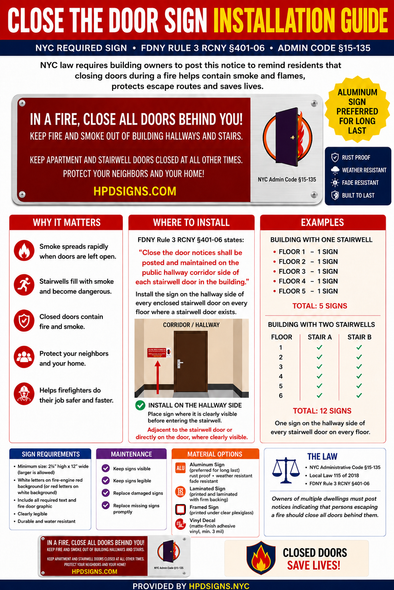
NYC Self-Closing DOOR requirements (pdf, V2026-11)

(No reviews yet) Write a Review
SKU:
NYC Self-Closing DOOR requirements (pdf, V2026-11)
MPN:
PDF SELF CLOSING DOOR
  • NYC SELF CLOSING DOOR HPD
  • HPD SELF CLOSING DOOR
  • NYC HPD self-closing-doors-owners
  • NYC HPD self-closing-doors-owners
$0.00
Frequently bought together:

Description

NYC Self-Closing Door Requirements 2026–2027: HPD Laws, Inspections, Violations & Building Owner Compliance Guide

NYC Administrative Code §§ 27-2041.1 and 27-2041.2 | Local Laws 111 of 2018, 63 of 2022 & 71 of 2022

Introduction: Why Self-Closing Doors Are Required in NYC Buildings

Self-closing doors are an essential fire safety requirement in New York City residential buildings. These doors help prevent smoke, flames, and dangerous gases from spreading between apartments, public hallways, corridors, and stairwells during a fire.

New York City building owners and property managers are responsible for ensuring that legally required self-closing doors are properly installed, maintained, and functioning.

The New York City Department of Housing Preservation and Development (HPD) enforces self-closing door maintenance requirements under NYC Administrative Code § 27-2041.1. Additional requirements are established under § 28-315.10 and the proactive inspection program under § 27-2041.2.

A defective self-closing door may result in an immediately hazardous Class C violation, mandatory repairs, civil penalties, and follow-up inspections.

This guide explains the applicable laws, which doors must be self-closing, how HPD conducts inspections, and what building owners should do to maintain compliance.

1. What Is a Self-Closing Door?

A self-closing door is equipped with a mechanism that automatically closes the door after it has been opened and released.

Depending on the door design and applicable requirements, this may include an overhead hydraulic door closer, spring hinges, or another approved closing mechanism.

A properly functioning self-closing door should:

  • Close automatically without being pushed or pulled.

  • Close completely after being opened.

  • Engage the latch where required.

  • Have properly functioning hinges and closing hardware.

  • Remain free of wedges, doorstops, and obstructions.

  • Maintain the required fire-protection function of the door assembly.

Installing a door closer does not automatically establish compliance. The entire door assembly must operate properly.

During a fire, an open apartment door can allow smoke and flames to enter a hallway or stairwell. A working self-closing door helps contain the fire and protect occupants.

2. NYC Administrative Code § 27-2041.1 — Self-Closing Doors

This section establishes the responsibility of multiple-dwelling owners to maintain legally required self-closing doors.

Section 27-2041.1(a): Building Owner Responsibility

Exact code quotation:

"It shall be the duty of the owner of a multiple dwelling, which is required to be equipped with self-closing doors pursuant to section 28-315.10, or any other applicable law, to keep and maintain such doors in good repair."

What this means:

Building owners must maintain required self-closing doors in working condition.

This obligation applies to doors required to be self-closing under § 28-315.10 or other applicable laws.

Owners should inspect apartment entrance doors, hallway doors, stairway doors, and other required self-closing doors to ensure that they close properly.

A door that remains open, fails to latch, has a broken closer, or cannot close because of an obstruction may violate this requirement.

Section 27-2041.1(b): Class C Immediately Hazardous Violations

Exact code quotation:

"Any owner required to keep and maintain self-closing doors pursuant to subdivision a of this section who fails to keep or maintain such doors shall be liable for a class C immediately hazardous violation."

The law further establishes a correction deadline of 14 days after service of the notice of violation.

What this means:

Failure to maintain a required self-closing door is considered an immediately hazardous housing condition.

Once HPD serves a violation, the building owner must correct the defective condition within the statutory correction period.

The owner should arrange repairs promptly rather than waiting until the end of the correction period.

Section 27-2041.1(c): Mandatory HPD Reinspection

Under this provision, HPD must conduct a reinspection no later than 20 days after the correction period expires, even if the owner submits a certification of correction.

For violations involving apartment entrance doors opening into interior corridors, HPD must make reasonable efforts to conduct the reinspection and notify the apartment occupant about access and rescheduling.

What this means:

Submitting a certification of correction does not eliminate the mandatory reinspection requirement.

The defective door must actually be repaired and operate correctly when inspected.

Section 27-2041.1(d): Civil Penalties

The law establishes the following civil penalties for violations of the self-closing door maintenance requirement:

  • Initial civil penalty: $250 to $500.

  • Additional continuing penalty: $250 per day.

  • The daily penalty runs from the date set for correction until the violation is corrected.

Actual penalties and enforcement depend on the applicable legal procedures and circumstances.

3. NYC Administrative Code § 28-315.10 — Which Doors Must Be Self-Closing?

NYC Administrative Code § 28-315.10 establishes self-closing requirements for doors providing access to interior corridors or stairs in occupancy groups R-1 and R-2.

The provision requires applicable doors to have a device that causes the door to return to its closed position and self-latch when opened and released.

The statutory compliance deadline was July 31, 2021.

Types of Doors That May Require Self-Closing Mechanisms

Apartment Entrance Doors

Apartment entrance doors that provide access to interior corridors or stairways must meet applicable self-closing requirements.

These doors help prevent fire and smoke from spreading from an apartment into shared evacuation routes.

Public Hallway and Corridor Doors

Doors separating public hallways, corridors, and other protected areas must have self-closing mechanisms where required by the applicable building or fire code.

Fire Stairway Doors

Required fire stairway doors must maintain their intended fire-protection and egress functions, including self-closing and latching where required.

Fire Tower Doors

Fire tower doors are subject to applicable fire safety and building code requirements intended to protect evacuation routes.

Building Entrance Doors

Some building entrance doors may require self-closing mechanisms depending on their location, occupancy classification, and applicable code provisions.

Not every exterior entrance door is automatically subject to the same requirement.

Bulkhead and Roof Access Doors

Bulkhead and roof access doors may be subject to self-closing or fire-protection requirements depending on the building design and applicable codes.

Rubbish Chute and Garbage Room Doors

Doors serving rubbish chutes and certain garbage or refuse areas may require self-closing and fire-rated assemblies under separate applicable building and fire safety provisions.

Commercial and Garage Access Doors

Doors connecting commercial spaces, garages, and residential areas may require self-closing mechanisms where required by fire separation or occupancy regulations.

Important: Not every door listed above is automatically required to be self-closing in every building. The actual requirement depends on the applicable building, housing maintenance, and fire safety codes.

4. Local Law 71 of 2022 — HPD Proactive Self-Closing Door Inspections

Local Law 71 of 2022 added NYC Administrative Code § 27-2041.2.

This law established a proactive inspection program requiring HPD to periodically inspect self-closing doors in selected Class A multiple dwellings.

Section 27-2041.2(a): General Requirement

The law directs HPD to develop and implement a process for periodic self-closing door inspections.

The program was required to be implemented by July 1, 2023.

Section 27-2041.2(b): Annual Building Selection

Exact code quotation:

"The department shall establish by rule criteria for annually selecting 300 class A multiple dwellings to be inspected pursuant to this section."

What this means:

HPD selects 300 qualifying Class A multiple dwellings annually for proactive self-closing door inspections.

The selection process considers building conditions, complaints, violations, and other fire safety factors.

The law also provides that buildings inspected under this particular program are not subject to inspection under the same section again for at least five years.

This does not prevent other legally authorized HPD inspections.

Section 27-2041.2(c): Inspection Process

HPD must inspect and test self-closing doors according to the law and applicable departmental rules.

The department establishes criteria for evaluating the operation of self-closing doors.

Section 27-2041.2(d): Inspection Locations

The law requires HPD to inspect self-closing doors in:

  • Common areas.

  • Public spaces.

  • Hallways.

  • Corridors.

  • Reasonably accessible dwelling units.

Apartment entrance doors are included where access can reasonably be obtained.

Section 27-2041.2(e): Annual Reporting

HPD must publish an annual report concerning buildings inspected through the proactive inspection program.

The report includes information such as:

  • Building address.

  • Building or property owner.

  • Inspection date.

  • Number of building floors.

  • Whether inspectors obtained access.

  • Number of self-closing door violations issued.

  • Number of violations corrected by the owner.

These reports provide information about the implementation and results of the inspection program.

5. 28 RCNY § 25-181 — How HPD Selects Buildings for Inspection

NYC HPD adopted rules establishing criteria for selecting buildings under the proactive self-closing door inspection program.

Under 28 RCNY § 25-181, buildings selected for this program must contain more than six dwelling units and meet at least one qualifying condition.

Qualifying Conditions

1. Self-Closing Door Complaints

Buildings with at least one HPD complaint regarding a self-closing door within the three years before selection.

2. Repeated Heat Complaints

Buildings with more than five heat complaints recorded by HPD in each of the three heating seasons before selection.

3. Fire Safety Violations

Buildings with at least one fire-safety-related violation issued by the NYC Department of Buildings within the preceding three years.

4. Missing Boiler Reports

Buildings that failed to file an applicable annual boiler report with DOB within the preceding three years.

Priority Buildings

HPD prioritizes qualifying buildings constructed before 1999.

The department also prioritizes buildings in consultation with the NYC Fire Department.

Excluded Buildings

The adopted rules exclude certain buildings already subject to specified enforcement programs or recent inspections, including qualifying buildings:

  • Under specified Article 7-A proceedings or orders.

  • Currently in the Alternative Enforcement Program.

  • Currently subject to an order under the Underlying Conditions Program.

  • Inspected under the proactive self-closing door program within the previous five years.

  • Subject to qualifying HPD public-part inspections within the preceding three years.

Owner Notification

HPD sends a notice to the registered owner or managing agent of a building selected for the proactive inspection program.

Important: Buildings with three to six apartments may still be required to maintain self-closing doors even though they do not qualify for selection under this particular annual inspection program.

6. How Building Owners Should Inspect Self-Closing Doors

HPD recommends testing doors to confirm that they operate correctly.

A door may appear undamaged while its closing mechanism is defective.

Self-Closing Door Inspection Checklist

[ ] Open the door fully and release it.

[ ] Verify that the door closes automatically without assistance.

[ ] Confirm that the door closes completely.

[ ] Verify that the latch engages properly where required.

[ ] Inspect the overhead closer or other closing mechanism.

[ ] Check hinges for damage, looseness, or missing components.

[ ] Inspect the door frame for damage or misalignment.

[ ] Check for excessive gaps or conditions affecting proper closure.

[ ] Remove wedges, doorstops, or unauthorized hold-open devices.

[ ] Check that the door does not strike the floor, frame, or other obstructions.

[ ] Verify that required fire-rated doors and hardware remain in proper condition.

[ ] Document defective doors and arrange prompt repairs.

[ ] Retest repaired doors to confirm proper operation.

[ ] Maintain appropriate inspection and repair records.

Property owners should inspect required doors periodically and respond promptly when tenants report problems.

7. Common Self-Closing Door Violations

Common defects that can cause a required self-closing door to fail include:

Broken Door Closers

A damaged or disconnected closer may prevent the door from returning to its closed position.

Doors That Do Not Latch

A door may appear closed but fail to engage its latch because of alignment, hardware, or closer problems.

Loose or Damaged Hinges

Damaged hinges may prevent the door from swinging and closing correctly.

Doors Propped Open

Wedges, kick-down stops, or other unauthorized devices can defeat the required self-closing function.

Damaged Door Frames

Warped or damaged frames may interfere with closing and latching.

Improperly Adjusted Closers

A closer may have insufficient force or an incorrect adjustment, preventing the door from fully closing.

Unauthorized Hardware Modifications

Removing closing devices, taping latches, or modifying required fire door assemblies may create unsafe conditions.

These defects should be evaluated and corrected promptly by qualified personnel.

8. What Happens After an HPD Self-Closing Door Violation?

When HPD identifies a defective required self-closing door, the enforcement process may include the following steps.

Step 1: Violation Issued

HPD issues a Class C immediately hazardous violation for failure to maintain the required door.

Step 2: Owner Receives Notice

The building owner receives the official notice of violation.

Step 3: Correct the Violation

The owner must correct the defective condition within 14 days after service of the notice.

Step 4: Submit Required Certification

The owner must follow applicable HPD procedures for certifying that the violation has been corrected.

Step 5: HPD Reinspection

HPD must conduct a reinspection within the period established by § 27-2041.1(c), regardless of whether the owner submitted a certification.

Step 6: Additional Enforcement if Necessary

Failure to correct a violation may result in continuing civil penalties and other authorized enforcement measures.

Owners should keep repair documentation and verify that the door operates properly.

9. Responsibilities of Building Owners and Tenants

Building Owners and Property Managers

Owners are responsible for maintaining required self-closing doors in good repair.

Recommended practices include:

  • Periodically testing self-closing doors.

  • Responding promptly to tenant complaints.

  • Repairing defective door closers and hinges.

  • Maintaining required latching hardware.

  • Keeping protected hallways and exits unobstructed.

  • Providing tenants with appropriate fire safety information.

  • Cooperating with authorized inspections.

  • Correcting HPD violations within required deadlines.

Tenants and Building Occupants

Tenants should help maintain building fire safety by:

  • Allowing required self-closing doors to close.

  • Avoiding wedges and unauthorized doorstops.

  • Not disconnecting or modifying door closers.

  • Not taping or disabling door latches.

  • Reporting malfunctioning doors to management.

  • Keeping exits and common hallways clear.

A self-closing door provides protection only when it is allowed to operate correctly.

10. Are Self-Closing Door Signs Required in NYC?

Building owners should distinguish between a legally required self-closing door mechanism and a separate signage requirement.

NYC Administrative Code §§ 27-2041.1 and 28-315.10 primarily address the maintenance and operation of self-closing doors.

These provisions do not establish a universal requirement to install a sign reading "SELF-CLOSING DOOR" on every self-closing door.

Depending on the building and location, other provisions may require fire safety notices, door identification, or related signage.

Examples of signs and notices commonly associated with building fire safety include:

  • SELF-CLOSING DOOR

  • KEEP DOOR CLOSED

  • CLOSE THE DOOR

  • FIRE DOOR KEEP CLOSED

  • FIRE SAFETY NOTICE

  • STAIRWAY IDENTIFICATION SIGNS

  • EXIT SIGNS

  • FIRE SAFETY AND EMERGENCY INFORMATION NOTICES

Not every listed sign is required in every building or location.

Building owners should verify the specific signage requirements applicable to their property.

Important: Installing a sign does not replace the requirement to maintain a properly functioning self-closing door.

11. Why Self-Closing Door Compliance Matters

Self-closing doors help protect residents, visitors, firefighters, and building occupants.

A properly maintained self-closing door can help:

  • Limit the spread of smoke.

  • Reduce the spread of flames and heat.

  • Protect public corridors.

  • Preserve safer evacuation routes.

  • Support stairway fire protection.

  • Reduce exposure to dangerous smoke.

  • Improve overall building fire safety.

A single defective apartment entrance door can compromise the protection provided by a corridor or stairway.

Routine inspection, maintenance, and prompt repair are important parts of responsible building management.

12. Frequently Asked Questions About NYC Self-Closing Door Laws

Q: Are self-closing doors required in NYC apartment buildings?

Yes. Applicable NYC laws require self-closing doors in multiple dwellings, including apartment entrance doors providing access to interior corridors or stairs where covered by the relevant code provisions.

Q: What is the main HPD code for self-closing doors?

NYC Administrative Code § 27-2041.1 establishes the owner's maintenance obligation. Section 28-315.10 establishes additional physical self-closing requirements.

Q: What is Local Law 71 of 2022?

Local Law 71 of 2022 created NYC Administrative Code § 27-2041.2, establishing proactive HPD inspections of self-closing doors in selected Class A multiple dwellings.

Q: How many buildings does HPD select annually?

The law requires HPD to select 300 qualifying Class A multiple dwellings annually for the proactive inspection program.

Q: What happens if an apartment door does not close automatically?

A defective door that is legally required to be self-closing may result in an HPD Class C immediately hazardous violation.

Q: How long does an owner have to correct a self-closing door violation?

Section 27-2041.1(b) establishes a correction period of 14 days after service of the notice of violation.

Q: What is the fine for a defective self-closing door?

Section 27-2041.1(d) establishes an initial civil penalty of $250 to $500, plus an additional $250 per day from the date set for correction until the violation is corrected.

Q: Does HPD reinspect self-closing door violations?

Yes. Section 27-2041.1(c) requires a reinspection within the statutory period, even when the owner submits a certification of correction.

Q: Does a building with fewer than seven apartments need self-closing doors?

The proactive inspection selection rules generally require more than six dwelling units. However, the underlying self-closing door laws may still apply to buildings containing three to six apartments.

Q: Can a tenant install a doorstop to keep an apartment entrance door open?

Tenants should not use unauthorized doorstops, wedges, or other devices that defeat a legally required self-closing function.

Q: Is a self-closing door sign required on every apartment door?

No universal signage requirement for every apartment door is established by §§ 27-2041.1 and 28-315.10. Separate applicable fire safety and signage rules should be reviewed.

13. Official NYC Legal References

Building owners and property managers should consult the current official laws and agency guidance.

NYC Administrative Code § 27-2041.1 — Self-Closing Doors

Owner maintenance obligations, Class C violations, correction periods, reinspections, and civil penalties.

https://codelibrary.amlegal.com/codes/newyorkcity/latest/NYCadmin/0-0-0-60471

NYC Administrative Code § 27-2041.2 — Self-Closing Doors; Required Inspections

HPD proactive inspection program, annual building selection, inspection requirements, and reporting.

https://codelibrary.amlegal.com/codes/newyorkcity/latest/NYCadmin/0-0-0-154685

NYC Administrative Code § 28-315.10 — Self-Closing Doors

Requirements for applicable doors providing access to interior corridors or stairs in R-1 and R-2 occupancies.

https://codelibrary.amlegal.com/codes/newyorkcity/latest/NYCadmin/0-0-0-158750

NYC HPD — Self-Closing Door Information

https://www.nyc.gov/site/hpd/services-and-information/self-closing-doors.page

NYC HPD — Inspections of Self-Closing Doors

https://rules.cityofnewyork.us/rule/inspections-of-self-closing-doors-2/

14. Important Legal Disclaimer and Compliance Notice

This article is provided by HPD Signs NYC, a small, independently owned and family-operated business based in Brooklyn, New York, solely for general educational, informational, and reference purposes. HPD Signs NYC is not affiliated with, sponsored by, approved by, endorsed by, authorized by, or acting on behalf of the City of New York or any municipal, state, or federal government agency, including but not limited to the NYC Department of Housing Preservation and Development (HPD), NYC Department of Buildings (DOB), Fire Department of the City of New York (FDNY), or any other governmental authority. References to government agencies, laws, regulations, and codes are provided exclusively for informational purposes and do not imply any governmental affiliation or endorsement.

Building owners, landlords, property managers, contractors, building operators, and other responsible parties are solely responsible for determining the laws, codes, regulations, inspection obligations, fire safety requirements, and signage requirements applicable to their specific premises. Legal requirements may vary depending on building occupancy, classification, construction date, building configuration, door location, and other circumstances. Laws and regulations may be amended or superseded without notice. This article may not include every applicable legal requirement, exception, or enforcement procedure. Readers must independently verify all requirements using current official government sources and consult qualified legal, engineering, fire safety, or building code professionals when appropriate.

HPD Signs NYC supplies signage and related products only and does not perform building inspections, fire safety evaluations, door installation, door repairs, code certifications, or compliance determinations. Purchasing or installing any sign does not guarantee compliance with applicable laws or satisfy requirements for functioning self-closing doors. Customers are responsible for confirming that all signs ordered are appropriate, complete, accurate, and compliant for their intended use and installation location. HPD Signs NYC makes no representation or warranty that this article or any product constitutes legal compliance, prevents violations, or guarantees any inspection outcome.

For additional NYC building safety signs and informational resources, visit:

https://hpdsigns.nyc

HPD Signs NYC — Independent Brooklyn-Based Building Safety Sign Supplier


LEGAL DISCLAIMER, LIMITATION OF LIABILITY, AND TERMS OF USE

INDEPENDENT SMALL FAMILY-OWNED BUSINESS NOTICE

We are an independent privately owned small family-owned business operating in the United States.

We are NOT the City of New York, HPD, DOB, FDNY, DSNY, DEP, DOT, DHCR, HUD, OSHA, EPA, FEMA, any state agency, any federal agency, or any governmental, quasi-governmental, regulatory, enforcement, housing, building, fire, transportation, sanitation, environmental, health, public safety, or public authority organization.

We are not affiliated with, endorsed by, approved by, sponsored by, authorized by, certified by, partnered with, or connected in any manner with any governmental agency or authority.

Any references to governmental agencies, laws, regulations, codes, standards, ordinances, inspections, notices, permits, requirements, compliance programs, enforcement actions, or public resources are provided solely for informational and descriptive purposes and do not imply endorsement, approval, certification, sponsorship, authorization, partnership, or affiliation.

Many governmental publications, flyers, brochures, forms, notices, checklists, and educational materials referenced, reproduced, summarized, attached, linked, or distributed by our company are publicly available documents that may be obtained directly from the applicable government agency, often at no charge.

INFORMATIONAL PURPOSES ONLY

All content, products, services, signs, sign packages, notices, brochures, flyers, downloadable files, PDF documents, checklists, product descriptions, blog articles, compliance guides, customer communications, emails, specifications, marketing materials, and related information are provided solely for general informational and educational purposes.

Information may become outdated, amended, revised, superseded, interpreted differently, or withdrawn without notice.

Laws, regulations, building codes, fire codes, housing requirements, inspection procedures, accessibility requirements, environmental regulations, insurance requirements, safety standards, and governmental policies frequently change and may vary by jurisdiction, occupancy type, building classification, property use, location, agency interpretation, and individual circumstances.

We make no representation, warranty, or guarantee that any information provided is accurate, complete, current, reliable, applicable, legally sufficient, or appropriate for any specific situation.

Users assume all risk associated with reliance upon any information provided.

NO PROFESSIONAL ADVICE

Nothing provided by our company shall be construed as:

• Legal advice
• Engineering advice
• Architectural advice
• Fire protection advice
• Life safety advice
• Accessibility advice
• ADA compliance advice
• Building code advice
• Fire code advice
• Housing code advice
• Inspection advice
• Regulatory advice
• Tax advice
• Insurance advice
• Real estate advice
• Environmental advice
• Construction advice
• Property management advice
• Professional consulting services of any kind

No attorney-client, consultant-client, architect-client, engineer-client, contractor-client, professional-client, or fiduciary relationship is created through the use of our website, purchase of products, receipt of materials, or communication with our company.

Customers should consult qualified attorneys, architects, engineers, code consultants, licensed contractors, fire protection professionals, insurance professionals, accountants, and applicable governmental authorities regarding their specific circumstances.

GOVERNMENT PUBLICATION DISCLAIMER

Any government-related document, brochure, flyer, checklist, guide, notice, publication, form, or educational material distributed by our company is provided solely as a convenience to customers.

Such materials remain the property of their respective agencies and organizations.

Our company does not create, maintain, update, approve, certify, validate, or control the contents of such governmental publications.

Government agencies may revise, amend, replace, withdraw, reinterpret, or update such materials at any time without notice.

Customers should always consult the original official governmental source for the most current information.

Official government publications, agency guidance, statutes, regulations, rules, code provisions, interpretations, and enforcement positions shall always control over any summary, reproduction, attachment, description, reference, or explanation provided by our company.

CUSTOMER RESPONSIBILITY FOR COMPLIANCE

The customer, property owner, landlord, management company, architect, engineer, contractor, installer, purchaser, building owner, consultant, and end user bear sole and exclusive responsibility for determining:

• Whether signage is required
• What signage is required
• Applicable laws and regulations
• Sign wording and content
• Sign dimensions and specifications
• Material requirements
• Installation requirements
• Placement requirements
• Inspection requirements
• Permit requirements
• Accessibility requirements
• Fire safety requirements
• Building safety requirements
• Environmental requirements
• Insurance requirements
• Operational requirements

Purchasing any sign, sign package, decal, placard, marker, notice, template, guide, checklist, flyer, brochure, or informational material from us does not constitute compliance with any law, code, regulation, ordinance, permit, inspection requirement, insurance requirement, governmental directive, court order, or regulatory obligation.

SIGNAGE DISCLAIMER

All signs, labels, notices, placards, decals, markers, plates, directories, room identification signs, building signs, compliance signs, and related products are provided solely as physical products.

We do not certify, guarantee, warrant, represent, or promise that any product:

• Meets any legal requirement
• Meets any code requirement
• Passes any inspection
• Satisfies any governmental requirement
• Creates legal compliance
• Creates regulatory compliance
• Meets insurance requirements
• Meets accessibility requirements
• Meets ADA requirements
• Meets OSHA requirements
• Meets FDNY requirements
• Meets HPD requirements
• Meets DOB requirements
• Prevents injury or property damage
• Eliminates legal obligations
• Eliminates regulatory obligations

The purchaser is solely responsible for determining suitability for the intended application.

INSTALLATION DISCLAIMER

Improper installation may create safety hazards, accessibility issues, regulatory violations, inspection failures, property damage, personal injury, or death.

We assume no responsibility whatsoever for:

• Installation methods
• Installation locations
• Placement decisions
• Fasteners selected
• Adhesive selection
• Structural attachment methods
• Mounting surfaces
• Electrical connections
• Maintenance practices
• Visibility requirements
• Accessibility requirements
• Inspection outcomes

All installation decisions remain the sole responsibility of the purchaser, installer, contractor, property owner, and building owner.

DISCLAIMER OF WARRANTIES

TO THE MAXIMUM EXTENT PERMITTED BY LAW, ALL PRODUCTS, SERVICES, INFORMATION, DOCUMENTS, DOWNLOADS, PUBLICATIONS, COMMUNICATIONS, AND MATERIALS ARE PROVIDED "AS IS," "WITH ALL FAULTS," AND "AS AVAILABLE."

WE EXPRESSLY DISCLAIM ALL WARRANTIES OF ANY KIND, WHETHER EXPRESS, IMPLIED, STATUTORY, OR OTHERWISE, INCLUDING WITHOUT LIMITATION:

• MERCHANTABILITY
• FITNESS FOR A PARTICULAR PURPOSE
• NON-INFRINGEMENT
• ACCURACY
• COMPLETENESS
• RELIABILITY
• PERFORMANCE
• DURABILITY
• CODE COMPLIANCE
• REGULATORY COMPLIANCE
• INSPECTION APPROVAL

NO ORAL OR WRITTEN STATEMENT SHALL CREATE ANY WARRANTY NOT EXPRESSLY SET FORTH IN A WRITTEN AGREEMENT SIGNED BY AN AUTHORIZED REPRESENTATIVE OF OUR COMPANY.

LIMITATION OF LIABILITY

TO THE MAXIMUM EXTENT PERMITTED BY LAW, OUR COMPANY, ITS OWNERS, FAMILY MEMBERS, EMPLOYEES, OFFICERS, DIRECTORS, AGENTS, REPRESENTATIVES, CONTRACTORS, SUCCESSORS, ASSIGNS, SUPPLIERS, DISTRIBUTORS, AFFILIATES, AND SERVICE PROVIDERS SHALL NOT BE LIABLE FOR ANY:

• Direct damages
• Indirect damages
• Consequential damages
• Incidental damages
• Special damages
• Punitive damages
• Exemplary damages
• Lost profits
• Lost revenue
• Lost business opportunities
• Business interruption damages
• Loss of use
• Loss of data
• Property damage
• Personal injury
• Bodily injury
• Death
• Government fines
• Civil penalties
• Violations
• Citations
• Inspection failures
• Enforcement actions
• Attorney fees
• Litigation expenses
• Regulatory actions

WHETHER ARISING FROM CONTRACT, TORT, NEGLIGENCE, STRICT LIABILITY, PRODUCT LIABILITY, WARRANTY, STATUTE, EQUITY, OR ANY OTHER LEGAL THEORY.

MAXIMUM LIABILITY CAP

IN ALL CIRCUMSTANCES, THE MAXIMUM AGGREGATE LIABILITY OF OUR COMPANY SHALL NOT EXCEED THE ACTUAL PURCHASE PRICE PAID FOR THE SPECIFIC PRODUCT THAT GAVE RISE TO THE CLAIM.

INDEMNIFICATION

The customer agrees to defend, indemnify, and hold harmless our company, its owners, family members, officers, employees, contractors, affiliates, successors, and assigns from and against any and all claims, demands, damages, losses, liabilities, penalties, fines, judgments, settlements, costs, expenses, and attorney fees arising from:

• Product use
• Product misuse
• Product installation
• Product modification
• Regulatory non-compliance
• Inspection failures
• Customer-provided content
• Customer instructions
• Property conditions
• Building conditions
• Third-party claims

THIRD-PARTY LINKS AND EXTERNAL RESOURCES

Any hyperlinks or references to government agencies, websites, laws, regulations, standards, organizations, publications, or third-party resources are provided solely as a convenience.

We do not control, endorse, verify, guarantee, maintain, or assume responsibility for third-party content and shall not be liable for any reliance placed upon such content.

GOVERNING LAW AND VENUE

This Legal Disclaimer, Limitation of Liability, and Terms of Use shall be governed by and construed under the laws of the State of New York, without regard to conflict-of-law principles.

Any dispute, claim, or legal proceeding shall be brought exclusively in the state or federal courts located within the State of New York.

ACCEPTANCE OF TERMS

By accessing our website, downloading materials, receiving information, purchasing products, requesting services, viewing content, or using any product, document, publication, flyer, guide, brochure, checklist, sign, or informational material provided by our company, the user acknowledges that they have read, understood, and agreed to be bound by this Legal Disclaimer, Limitation of Liability, and Terms of Use.

View AllClose