NYC Cooling Tower Signs & Building Owner Checklist ( pdf 2026)
(No reviews yet) Write a Review
SKU:
NYC Cooling Tower Signs & Building Owner Checklist ( pdf 2026)
MPN:
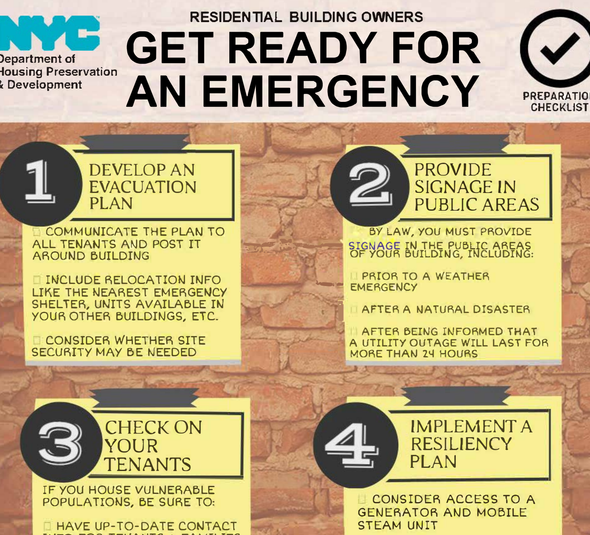
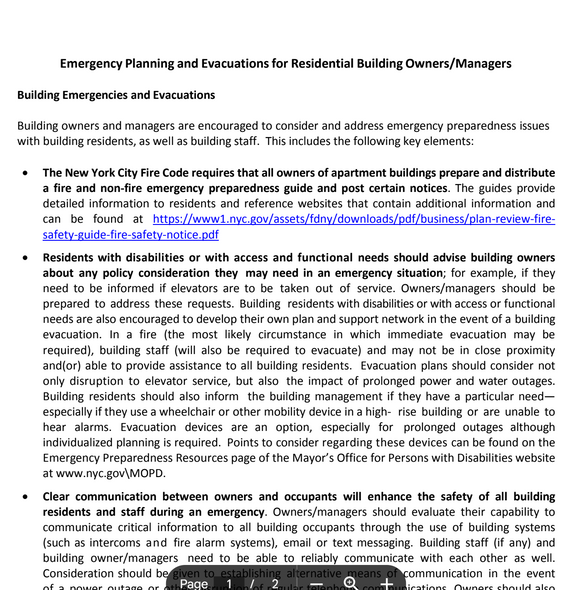
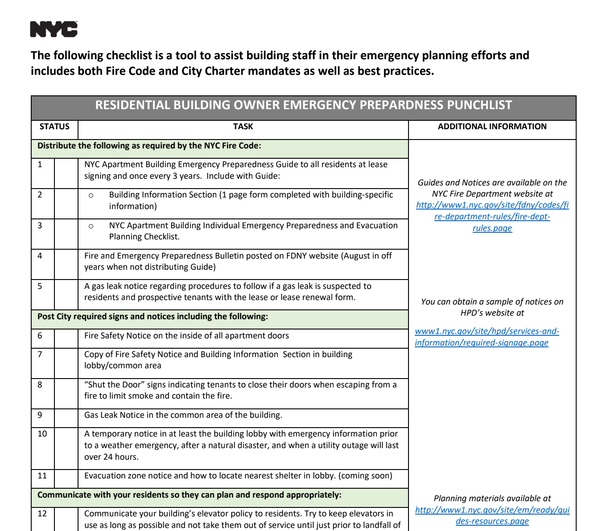
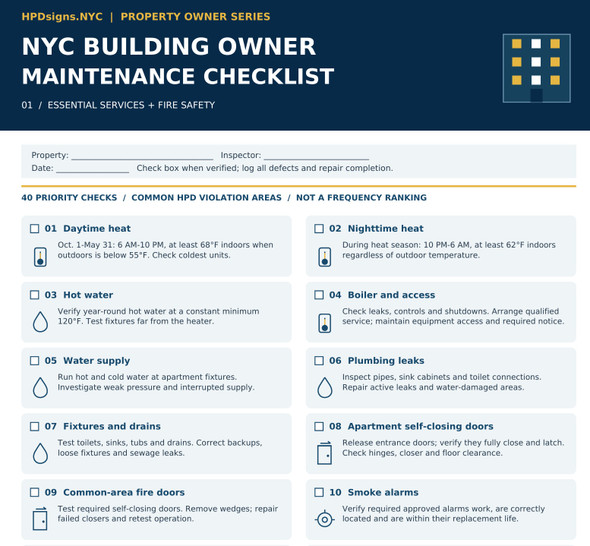
NYC Building Maintenance Checklist
$0.00
Frequently bought together:

Description

NYC Cooling Tower Signage Requirements & Building Owner Safety Checklist

Complete Guide to Cooling Tower Safety Signs, Registration Notices, Warning Signs & Equipment Identification in New York City

Cooling towers are essential components of many commercial, residential, industrial, and mixed-use buildings throughout New York City. These systems help regulate building temperatures by removing heat from circulating water. However, cooling towers also present potential safety hazards, including exposure to Legionella bacteria, rotating mechanical equipment, electrical hazards, elevated work areas, and unauthorized access.

Proper cooling tower signage is an important part of building safety, equipment identification, emergency preparedness, and maintenance operations.

NYC building owners and property managers must comply with applicable cooling tower registration, inspection, cleaning, disinfection, testing, and maintenance requirements. These requirements are addressed through New York City laws and regulations, including NYC Administrative Code Article 317 and applicable NYC Department of Health and Mental Hygiene rules.

Not every cooling tower safety sign is specifically required by NYC law. Some signs support regulatory compliance, while others are recommended for workplace safety, equipment identification, emergency access, or building management.

HPD Signs NYC offers a selection of cooling tower identification signs, safety notices, warning signs, and equipment labels to help building owners maintain clearly identified and properly organized mechanical areas.

Why Is Cooling Tower Signage Important in NYC?

Properly selected and installed signage serves several important purposes:

  1. Building Safety: Warns maintenance personnel, contractors, and visitors about mechanical equipment, moving parts, fall hazards, and restricted areas.

  2. Emergency Preparedness: Helps emergency responders and maintenance personnel identify cooling tower equipment, emergency contacts, and shutoff locations.

  3. Regulatory Awareness: Supports building owners in communicating important operational information and maintaining organized cooling tower facilities.

  4. Unauthorized Access Prevention: Identifies areas restricted to trained or authorized personnel.

  5. Maintenance Efficiency: Makes it easier to locate equipment, electrical disconnects, water shutoff valves, and mechanical rooms.

  6. Inspection Readiness: Helps owners verify that necessary signs remain visible, legible, accurate, and properly installed.

  7. Risk Reduction: Clear warnings can help reduce preventable accidents, equipment damage, and confusion during maintenance or emergency situations.

Signage does not replace inspections, employee training, protective equipment, physical barriers, lockout/tagout procedures, or other legally required safety measures.


Complete NYC Cooling Tower Signage Guide — 12 Signs Explained

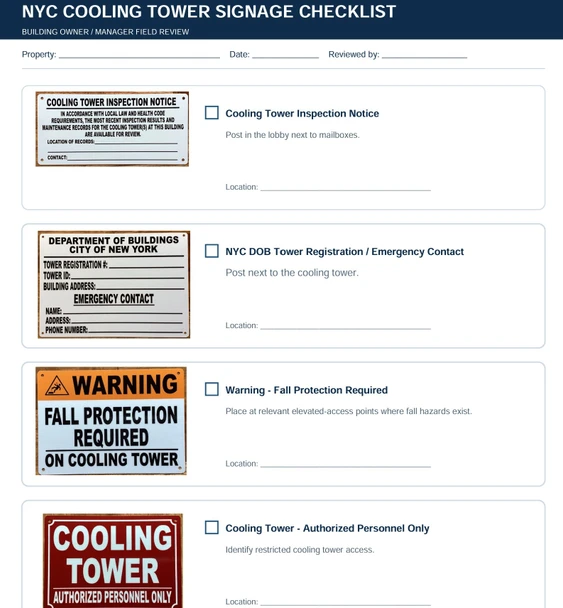
1. Cooling Tower Inspection Notice

Recommended Installation Location: Building lobby, next to the mailboxes.

The Cooling Tower Inspection Notice informs building occupants, maintenance personnel, and authorized visitors that cooling tower inspection results and maintenance records are available for review at the location identified on the sign.

This sign provides a clearly designated point of contact for questions concerning cooling tower inspection documentation and maintenance records.

Why This Sign Is Important: It helps building management communicate where records are maintained, reduces confusion when records are requested, and supports an organized documentation system.

Building owners should complete the location-of-records and contact fields, keep the information current, and ensure that the identified records are available to legally authorized inspectors.

Compliance Note: NYC requires cooling tower records to be maintained and made available to the Health Department. The lobby inspection notice itself is not established as a universal posting requirement under 24 RCNY Chapter 8.

2. NYC DOB Cooling Tower Registration / Emergency Contact Sign

Required Registration Number Placement: Conspicuously visible, securely fastened directly to each cooling tower.

The NYC DOB Cooling Tower Registration / Emergency Contact Sign identifies the cooling tower and provides space for essential information, including the tower registration number, tower ID, building address, emergency contact name, address, and telephone number.

Why This Sign Is Important: Correct equipment identification allows inspectors, building personnel, and emergency responders to distinguish individual cooling towers, especially when multiple systems are installed at the same property.

Under 24 RCNY § 8-07(c), the NYC DOB cooling tower registration number must be displayed on each cooling tower using a securely fastened, durable, weather-resistant sign or plate in a conspicuous location.

The emergency contact fields are useful additional information, but the cited posting rule specifically requires the registration number.

3. Warning — Fall Protection Required on Cooling Tower

Recommended Installation Location: Cooling tower access points, elevated platforms, rooftop approaches, and designated fall-hazard areas.

Cooling towers are frequently installed on rooftops or elevated mechanical structures. Workers inspecting or servicing these systems may be exposed to unprotected edges, elevated walkways, ladders, and slippery surfaces.

A Fall Protection Required sign warns workers to recognize elevated-work hazards and follow applicable safety procedures.

Why This Sign Is Important: Falls from height can cause serious injuries or fatalities. Warning signs reinforce awareness of hazardous areas and the need for appropriate protective measures.

The sign does not replace guardrails, approved fall-protection systems, training, or other applicable OSHA requirements.

4. Cooling Tower — Authorized Personnel Only

Recommended Installation Location: Cooling tower entrance, rooftop mechanical area, access gate, or equipment enclosure.

This sign identifies the cooling tower as a restricted mechanical area and communicates that access should be limited to authorized personnel.

Cooling towers may contain moving equipment, chemical treatment systems, electrical components, slippery surfaces, and other operational hazards.

Why This Sign Is Important: Restricting access helps protect residents, visitors, delivery personnel, and untrained workers from entering areas where they could encounter dangerous equipment.

The sign is particularly useful in buildings where roof access or mechanical spaces may be shared with other building operations.

5. Cooling Tower Area — No Smoking, E-Cigarettes, Vaping, or Open Flames

Recommended Installation Location: Cooling tower area entrance, mechanical enclosure, or designated restricted zone.

This sign communicates smoking, vaping, and open-flame restrictions while identifying the area as accessible only to authorized personnel.

Cooling tower facilities may contain electrical systems, chemical storage, water treatment products, and other equipment requiring careful handling.

Why This Sign Is Important: Clear warnings support building safety policies, discourage prohibited activities, and remind workers to follow site-specific fire-prevention procedures.

The sign is particularly appropriate where smoking or ignition sources are restricted by applicable fire regulations, chemical safety procedures, or building management rules.

6. Cooling Tower Disconnect Sign

Recommended Installation Location: At the cooling tower electrical disconnect, with the arrow pointing accurately toward the disconnect.

A Cooling Tower Disconnect sign helps identify the electrical isolation point used to disconnect power from cooling tower equipment.

Why This Sign Is Important: During maintenance, equipment malfunction, or emergency response, personnel may need to identify the correct electrical disconnect quickly.

Clear identification helps prevent confusion between adjacent cooling towers, fans, pumps, and other mechanical systems.

The sign must point to the correct disconnect. It does not replace electrical labeling, approved lockout/tagout procedures, or verification that equipment has been safely de-energized.

7. Warning — Rotating Fan Blades

Recommended Installation Location: Near cooling tower fan access panels, fan housings, service doors, and other areas where rotating components present a hazard.

Cooling towers commonly use large mechanical fans to move air through the system. These fans may cause severe injuries if workers contact moving blades or access equipment before it is safely shut down.

A Rotating Fan Blades warning sign reminds maintenance personnel to keep hands clear and turn off and lock out equipment before servicing.

Why This Sign Is Important: It reinforces safe maintenance practices and communicates mechanical hazards to workers approaching the equipment.

Some fan systems may also start automatically through building controls. Appropriate isolation and verification procedures are essential before maintenance begins.

8. Cooling Tower Storage Room — Authorized Personnel Only

Recommended Installation Location: Entrance door of the designated cooling tower storage room.

This sign identifies a room used for cooling tower-related supplies, replacement components, maintenance materials, or approved treatment products.

Why This Sign Is Important: Proper room identification helps employees locate maintenance supplies and discourages unauthorized entry into restricted storage areas.

Where chemicals are stored, owners must also evaluate applicable chemical hazard communication, fire code, ventilation, and storage requirements. A general storage-room sign does not replace required chemical identification or hazard warnings.

9. Cooling Tower Equipment Room — Authorized Personnel Only

Recommended Installation Location: Entrance door of the cooling tower mechanical or equipment room.

This sign identifies the room containing cooling tower-related mechanical systems, such as pumps, piping, controls, valves, electrical equipment, or treatment components.

Why This Sign Is Important: Clearly identifying the equipment room helps maintenance workers, contractors, inspectors, and emergency personnel locate the appropriate mechanical area.

Restricting access also reduces the possibility of unauthorized interference with building equipment.

10. Main Water Shut-Off Sign

Recommended Installation Location: At or immediately adjacent to the main water shutoff valve serving the applicable system.

A Main Water Shut-Off sign identifies the location of a critical valve used to isolate water supply.

Why This Sign Is Important: During a pipe failure, uncontrolled leak, equipment repair, or other water-related emergency, rapid identification of the correct valve may reduce water damage and equipment downtime.

Owners should verify that the sign identifies the intended valve. Where several systems have separate shutoffs, more specific identification may be necessary to avoid confusion.

11. Air Vent Directly Below — Keep Clear of All Obstructions

Recommended Installation Location: Directly above or adjacent to the relevant air vent, where the arrows accurately indicate its position.

This sign identifies an air vent and reminds personnel not to obstruct the designated opening.

Why This Sign Is Important: Obstructed ventilation openings can interfere with equipment performance or ventilation functions, depending on the system design.

Clear labeling helps discourage storage, construction materials, or other objects from being placed in front of critical openings.

The owner or mechanical contractor should verify the vent's purpose and applicable clearance requirements.

12. Authorized Access Only — Landlord Permission Required

Recommended Installation Location: Rooftop access door, cooling tower access gate, mechanical-room entrance, or another designated restricted-access point.

This sign advises visitors and contractors that permission from building management is required before entering the restricted area.

The sign includes space for a contact telephone number.

Why This Sign Is Important: It helps building management control access, coordinate contractor visits, and discourage unauthorized entry into areas containing potentially hazardous mechanical equipment.

This sign is especially useful in multifamily and mixed-use buildings where residents or other building occupants may have access to nearby common areas.


Additional Sign for Permanently Decommissioned Cooling Towers

Decommissioned Cooling Tower — Do Not Fill With Water or Operate

Required When Applicable: On decommissioned cooling tower equipment that remains physically installed.

The 2026 amendment to 24 RCNY § 8-06(d) requires a conspicuously visible, durable, weather-resistant sign or plate when decommissioned cooling tower equipment has not been physically removed.

The notice must indicate that the equipment is not registered with NYC and must not be filled with water or placed into operation.

This is an additional conditional requirement beyond the 12 signs in the standard checklist.


NYC Cooling Tower Signage Inspection Checklist for Building Owners

Property Information

Building Address: __________________________________

Borough: __________________________________

Cooling Tower Registration Number: __________________________________

Cooling Tower ID: __________________________________

Inspection Date: __________________________________

Inspected By: __________________________________

A. Registration, Documentation & Identification

  • ☐ 1. Cooling Tower Inspection Notice — Posted in the building lobby next to the mailboxes. Records location and contact information completed.

  • ☐ 2. NYC DOB Tower Registration / Emergency Contact — Posted directly on the cooling tower, with the registration number securely fastened and conspicuously visible on each tower. Emergency contact information completed and current.

B. Safety & Hazard Warning Signs

  • ☐ 3. Fall Protection Required on Cooling Tower — Installed at applicable elevated-work and fall-hazard areas.

  • ☐ 4. Cooling Tower — Authorized Personnel Only — Installed at the cooling tower entrance or restricted-access area.

  • ☐ 5. Cooling Tower Area — No Smoking, E-Cigarettes, Vaping, or Open Flames — Installed at applicable cooling tower area entrances.

  • ☐ 6. Cooling Tower Disconnect — Installed at the correct electrical disconnect, with the arrow pointing in the correct direction.

  • ☐ 7. Warning — Rotating Fan Blades — Installed near applicable fan equipment and service-access locations.

C. Mechanical Room & Equipment Identification

  • ☐ 8. Cooling Tower Storage Room — Authorized Personnel Only — Installed on the designated storage-room entrance.

  • ☐ 9. Cooling Tower Equipment Room — Authorized Personnel Only — Installed on the designated mechanical-room entrance.

  • ☐ 10. Main Water Shut-Off — Installed at the appropriate water shutoff valve.

  • ☐ 11. Air Vent Directly Below — Keep Clear of All Obstructions — Installed near the applicable vent, with the opening and required clearances unobstructed.

  • ☐ 12. Authorized Access Only — Landlord Permission Required — Installed at the designated restricted-access entrance, with current contact information.

D. Additional Conditional Signage

  • ☐ Decommissioned Cooling Tower Notice — Installed on applicable decommissioned equipment that remains in place, in accordance with 24 RCNY § 8-06(d).

  • ☐ Other Site-Specific Safety Signs — Additional electrical, chemical, confined-space, fire safety, or equipment identification signs evaluated and installed where applicable.

E. Final Signage Inspection

  • ☐ All required registration numbers are accurately displayed.

  • ☐ All applicable signs are securely mounted.

  • ☐ Outdoor signs are suitable for weather exposure.

  • ☐ Signs are clearly visible and legible.

  • ☐ No signs are missing, damaged, faded, or obstructed.

  • ☐ Emergency contact information is accurate.

  • ☐ Equipment labels match the equipment they identify.

  • ☐ Directional arrows point to the correct equipment or valve.

  • ☐ Restricted-access areas have appropriate access controls.

  • ☐ Additional requirements have been reviewed with the qualified cooling tower professional.

Inspection Result: ☐ Satisfactory ☐ Corrective Action Required ☐ Further Review Needed

Corrective Actions / Missing Signs:


Date Completed: __________________________________

Owner / Manager Signature: __________________________________

This is a general signage checklist, not a certification of regulatory compliance. Check each sign for applicability; not all 12 signs are universally required.


NYC Cooling Tower Regulations Building Owners Should Know

NYC Administrative Code Article 317: Establishes cooling tower registration, certification, and related owner responsibilities.

24 RCNY Chapter 8: Addresses cooling tower maintenance, monitoring, testing, records, and administrative requirements.

24 RCNY § 8-07(c): Addresses required posting of the cooling tower registration number.

24 RCNY § 8-06(d): Addresses decommissioning requirements, including applicable signage.

OSHA 29 CFR 1910: Contains workplace safety standards that may apply to cooling tower equipment and maintenance activities.

NYC Fire Code: Contains applicable fire prevention, chemical storage, and safety requirements.

Important 2026 Regulatory Update: NYC Administrative Code § 28-317.5 was amended effective November 3, 2026, to require biannual certification, generally in January and July or as otherwise specified by regulation. Building owners should confirm current filing procedures and deadlines with the responsible agency.

In addition to signage, NYC cooling tower owners must maintain appropriate maintenance programs, water treatment, monitoring, testing, cleaning, disinfection, and records. The NYC Health Department requires applicable maintenance records to be retained for at least three years.

Why Building Owners Should Inspect Cooling Tower Signs Regularly

Cooling tower signs can become damaged or unreadable from exposure to sunlight, rain, snow, corrosion, cleaning chemicals, and routine mechanical work.

Building owners should include signage checks in their regular property maintenance inspections. Particular attention should be given to outdoor registration plates, emergency contact notices, electrical disconnect labels, restricted-access signs, and mechanical hazard warnings.

Whenever cooling tower equipment is replaced, modified, relocated, or decommissioned, the owner should review existing signage to determine whether identification or safety notices must be updated.

A properly maintained signage system can improve communication among building staff, contractors, inspectors, and emergency responders.

Cooling Tower Signs for NYC Buildings — HPD Signs NYC

HPD Signs NYC supplies cooling tower identification signs, registration notices, safety warnings, mechanical-room signs, and equipment labels for commercial, residential, and mixed-use properties throughout New York City.

Our cooling tower sign selection includes registration and emergency contact signs, inspection notices, authorized personnel signs, fall protection warnings, rotating fan blade warnings, electrical disconnect signs, water shutoff identification, and other building safety signs.

Shop Cooling Tower Signs:

https://hpdsigns.nyc/cooling-towers-signs/


IMPORTANT LEGAL DISCLAIMER & COMPLIANCE NOTICE

This cooling tower signage article and checklist are provided by HPD Signs NYC, a small, independently owned business, for general informational, educational, and reference purposes only. HPD Signs NYC is not affiliated with, endorsed by, authorized by, or acting on behalf of the New York City Department of Buildings (DOB), New York City Department of Health and Mental Hygiene (DOHMH), New York City Fire Department (FDNY), Occupational Safety and Health Administration (OSHA), or any other federal, state, or local government agency. References to NYC laws, regulations, agencies, and safety standards are provided solely to assist readers in identifying potentially applicable requirements. The signage described in this article includes examples of registration, identification, operational, warning, and safety signs. Not every sign listed is legally required at every building or cooling tower installation. This article and checklist are not official government publications, legal opinions, engineering assessments, inspection reports, or certifications of regulatory compliance. Laws, regulations, interpretations, and enforcement practices may change without notice.

Building owners, property managers, cooling tower operators, contractors, and purchasers are solely responsible for determining the complete and current signage requirements applicable to their particular buildings, cooling tower systems, equipment, and operations. They are responsible for verifying all applicable laws and regulations, selecting appropriate signs, confirming the completeness and accuracy of their sign lists, and ensuring proper installation, placement, visibility, maintenance, and replacement of signage. HPD Signs NYC does not perform building inspections, engineering evaluations, code-compliance determinations, or sign installation services. The purchase, possession, or installation of any sign supplied by HPD Signs NYC does not establish or guarantee compliance with NYC laws, OSHA standards, fire safety regulations, or any other legal requirement. This checklist may omit signs, notices, or warnings required under particular circumstances. Customers should consult qualified building professionals, licensed contractors, safety specialists, or the appropriate government agencies before relying on any signage selection for regulatory compliance. To the extent permitted by applicable law, HPD Signs NYC disclaims responsibility for errors, omissions, improper selection or placement, regulatory violations, penalties, property damage, or injuries arising from reliance on this informational material. Any contractual limitations of liability are subject to applicable law and the company's governing terms and conditions.


LEGAL DISCLAIMER, LIMITATION OF LIABILITY, AND TERMS OF USE

INDEPENDENT SMALL FAMILY-OWNED BUSINESS NOTICE

We are an independent privately owned small family-owned business operating in the United States.

We are NOT the City of New York, HPD, DOB, FDNY, DSNY, DEP, DOT, DHCR, HUD, OSHA, EPA, FEMA, any state agency, any federal agency, or any governmental, quasi-governmental, regulatory, enforcement, housing, building, fire, transportation, sanitation, environmental, health, public safety, or public authority organization.

We are not affiliated with, endorsed by, approved by, sponsored by, authorized by, certified by, partnered with, or connected in any manner with any governmental agency or authority.

Any references to governmental agencies, laws, regulations, codes, standards, ordinances, inspections, notices, permits, requirements, compliance programs, enforcement actions, or public resources are provided solely for informational and descriptive purposes and do not imply endorsement, approval, certification, sponsorship, authorization, partnership, or affiliation.

Many governmental publications, flyers, brochures, forms, notices, checklists, and educational materials referenced, reproduced, summarized, attached, linked, or distributed by our company are publicly available documents that may be obtained directly from the applicable government agency, often at no charge.

INFORMATIONAL PURPOSES ONLY

All content, products, services, signs, sign packages, notices, brochures, flyers, downloadable files, PDF documents, checklists, product descriptions, blog articles, compliance guides, customer communications, emails, specifications, marketing materials, and related information are provided solely for general informational and educational purposes.

Information may become outdated, amended, revised, superseded, interpreted differently, or withdrawn without notice.

Laws, regulations, building codes, fire codes, housing requirements, inspection procedures, accessibility requirements, environmental regulations, insurance requirements, safety standards, and governmental policies frequently change and may vary by jurisdiction, occupancy type, building classification, property use, location, agency interpretation, and individual circumstances.

We make no representation, warranty, or guarantee that any information provided is accurate, complete, current, reliable, applicable, legally sufficient, or appropriate for any specific situation.

Users assume all risk associated with reliance upon any information provided.

NO PROFESSIONAL ADVICE

Nothing provided by our company shall be construed as:

• Legal advice
• Engineering advice
• Architectural advice
• Fire protection advice
• Life safety advice
• Accessibility advice
• ADA compliance advice
• Building code advice
• Fire code advice
• Housing code advice
• Inspection advice
• Regulatory advice
• Tax advice
• Insurance advice
• Real estate advice
• Environmental advice
• Construction advice
• Property management advice
• Professional consulting services of any kind

No attorney-client, consultant-client, architect-client, engineer-client, contractor-client, professional-client, or fiduciary relationship is created through the use of our website, purchase of products, receipt of materials, or communication with our company.

Customers should consult qualified attorneys, architects, engineers, code consultants, licensed contractors, fire protection professionals, insurance professionals, accountants, and applicable governmental authorities regarding their specific circumstances.

GOVERNMENT PUBLICATION DISCLAIMER

Any government-related document, brochure, flyer, checklist, guide, notice, publication, form, or educational material distributed by our company is provided solely as a convenience to customers.

Such materials remain the property of their respective agencies and organizations.

Our company does not create, maintain, update, approve, certify, validate, or control the contents of such governmental publications.

Government agencies may revise, amend, replace, withdraw, reinterpret, or update such materials at any time without notice.

Customers should always consult the original official governmental source for the most current information.

Official government publications, agency guidance, statutes, regulations, rules, code provisions, interpretations, and enforcement positions shall always control over any summary, reproduction, attachment, description, reference, or explanation provided by our company.

CUSTOMER RESPONSIBILITY FOR COMPLIANCE

The customer, property owner, landlord, management company, architect, engineer, contractor, installer, purchaser, building owner, consultant, and end user bear sole and exclusive responsibility for determining:

• Whether signage is required
• What signage is required
• Applicable laws and regulations
• Sign wording and content
• Sign dimensions and specifications
• Material requirements
• Installation requirements
• Placement requirements
• Inspection requirements
• Permit requirements
• Accessibility requirements
• Fire safety requirements
• Building safety requirements
• Environmental requirements
• Insurance requirements
• Operational requirements

Purchasing any sign, sign package, decal, placard, marker, notice, template, guide, checklist, flyer, brochure, or informational material from us does not constitute compliance with any law, code, regulation, ordinance, permit, inspection requirement, insurance requirement, governmental directive, court order, or regulatory obligation.

SIGNAGE DISCLAIMER

All signs, labels, notices, placards, decals, markers, plates, directories, room identification signs, building signs, compliance signs, and related products are provided solely as physical products.

We do not certify, guarantee, warrant, represent, or promise that any product:

• Meets any legal requirement
• Meets any code requirement
• Passes any inspection
• Satisfies any governmental requirement
• Creates legal compliance
• Creates regulatory compliance
• Meets insurance requirements
• Meets accessibility requirements
• Meets ADA requirements
• Meets OSHA requirements
• Meets FDNY requirements
• Meets HPD requirements
• Meets DOB requirements
• Prevents injury or property damage
• Eliminates legal obligations
• Eliminates regulatory obligations

The purchaser is solely responsible for determining suitability for the intended application.

INSTALLATION DISCLAIMER

Improper installation may create safety hazards, accessibility issues, regulatory violations, inspection failures, property damage, personal injury, or death.

We assume no responsibility whatsoever for:

• Installation methods
• Installation locations
• Placement decisions
• Fasteners selected
• Adhesive selection
• Structural attachment methods
• Mounting surfaces
• Electrical connections
• Maintenance practices
• Visibility requirements
• Accessibility requirements
• Inspection outcomes

All installation decisions remain the sole responsibility of the purchaser, installer, contractor, property owner, and building owner.

DISCLAIMER OF WARRANTIES

TO THE MAXIMUM EXTENT PERMITTED BY LAW, ALL PRODUCTS, SERVICES, INFORMATION, DOCUMENTS, DOWNLOADS, PUBLICATIONS, COMMUNICATIONS, AND MATERIALS ARE PROVIDED "AS IS," "WITH ALL FAULTS," AND "AS AVAILABLE."

WE EXPRESSLY DISCLAIM ALL WARRANTIES OF ANY KIND, WHETHER EXPRESS, IMPLIED, STATUTORY, OR OTHERWISE, INCLUDING WITHOUT LIMITATION:

• MERCHANTABILITY
• FITNESS FOR A PARTICULAR PURPOSE
• NON-INFRINGEMENT
• ACCURACY
• COMPLETENESS
• RELIABILITY
• PERFORMANCE
• DURABILITY
• CODE COMPLIANCE
• REGULATORY COMPLIANCE
• INSPECTION APPROVAL

NO ORAL OR WRITTEN STATEMENT SHALL CREATE ANY WARRANTY NOT EXPRESSLY SET FORTH IN A WRITTEN AGREEMENT SIGNED BY AN AUTHORIZED REPRESENTATIVE OF OUR COMPANY.

LIMITATION OF LIABILITY

TO THE MAXIMUM EXTENT PERMITTED BY LAW, OUR COMPANY, ITS OWNERS, FAMILY MEMBERS, EMPLOYEES, OFFICERS, DIRECTORS, AGENTS, REPRESENTATIVES, CONTRACTORS, SUCCESSORS, ASSIGNS, SUPPLIERS, DISTRIBUTORS, AFFILIATES, AND SERVICE PROVIDERS SHALL NOT BE LIABLE FOR ANY:

• Direct damages
• Indirect damages
• Consequential damages
• Incidental damages
• Special damages
• Punitive damages
• Exemplary damages
• Lost profits
• Lost revenue
• Lost business opportunities
• Business interruption damages
• Loss of use
• Loss of data
• Property damage
• Personal injury
• Bodily injury
• Death
• Government fines
• Civil penalties
• Violations
• Citations
• Inspection failures
• Enforcement actions
• Attorney fees
• Litigation expenses
• Regulatory actions

WHETHER ARISING FROM CONTRACT, TORT, NEGLIGENCE, STRICT LIABILITY, PRODUCT LIABILITY, WARRANTY, STATUTE, EQUITY, OR ANY OTHER LEGAL THEORY.

MAXIMUM LIABILITY CAP

IN ALL CIRCUMSTANCES, THE MAXIMUM AGGREGATE LIABILITY OF OUR COMPANY SHALL NOT EXCEED THE ACTUAL PURCHASE PRICE PAID FOR THE SPECIFIC PRODUCT THAT GAVE RISE TO THE CLAIM.

INDEMNIFICATION

The customer agrees to defend, indemnify, and hold harmless our company, its owners, family members, officers, employees, contractors, affiliates, successors, and assigns from and against any and all claims, demands, damages, losses, liabilities, penalties, fines, judgments, settlements, costs, expenses, and attorney fees arising from:

• Product use
• Product misuse
• Product installation
• Product modification
• Regulatory non-compliance
• Inspection failures
• Customer-provided content
• Customer instructions
• Property conditions
• Building conditions
• Third-party claims

THIRD-PARTY LINKS AND EXTERNAL RESOURCES

Any hyperlinks or references to government agencies, websites, laws, regulations, standards, organizations, publications, or third-party resources are provided solely as a convenience.

We do not control, endorse, verify, guarantee, maintain, or assume responsibility for third-party content and shall not be liable for any reliance placed upon such content.

GOVERNING LAW AND VENUE

This Legal Disclaimer, Limitation of Liability, and Terms of Use shall be governed by and construed under the laws of the State of New York, without regard to conflict-of-law principles.

Any dispute, claim, or legal proceeding shall be brought exclusively in the state or federal courts located within the State of New York.

ACCEPTANCE OF TERMS

By accessing our website, downloading materials, receiving information, purchasing products, requesting services, viewing content, or using any product, document, publication, flyer, guide, brochure, checklist, sign, or informational material provided by our company, the user acknowledges that they have read, understood, and agreed to be bound by this Legal Disclaimer, Limitation of Liability, and Terms of Use.

View AllClose