
hpdsigns.nyc
NY Security Deposit Laws & Rent Rules for Landlords (pdf file, 2026)

- SKU:
- NY Security Deposit Laws & Rent Rules for Landlords (pdf file, 2026)
- MPN:
- Rent Rules for Landlords

Description
NEW YORK RENT & SECURITY DEPOSIT RULES FOR LANDLORDS
New York landlords must follow specific rules when collecting rent, charging late fees, holding security deposits, and returning security deposits at the end of a tenancy. The following is a practical summary for property owners and managers.
RENT CHARGES
For apartments that are not rent regulated, the landlord and tenant generally may agree upon the monthly rent.
For rent-regulated apartments, the legal rent and permitted rent increases are governed by New York rent-regulation laws. Landlords of rent-regulated apartments should verify the legal regulated rent and any permitted increases before changing the rent.
LATE FEES
A landlord may not charge a late fee until the rent payment has remained unpaid for more than five days after it is due.
The maximum late fee is:
$50 or 5% of the monthly rent, whichever is LESS.
Example:
Monthly Rent: $2,000
5% of Rent: $100
Maximum Late Fee: $50
If the monthly rent is $700:
5% of Rent: $35
Maximum Late Fee: $35
RENT RECEIPTS
New York law requires landlords to provide written receipts for certain forms of rent payment, including cash.
Landlords should maintain clear records showing the rent received, payment date, rental period covered, and any outstanding balance.
SECURITY DEPOSITS
HOW MUCH SECURITY DEPOSIT CAN A LANDLORD COLLECT?
A residential security deposit is generally limited to no more than one month's rent.
Example:
Monthly Rent: $2,500
Maximum Security Deposit: $2,500
A landlord generally cannot require a tenant to pay both a one-month security deposit and an additional "last month's rent" when doing so would exceed the statutory one-month limit.
WHAT HAPPENS WHEN THE RENT INCREASES?
If the rent increases, the landlord may request enough additional money to bring the security deposit up to the amount of the new monthly rent.
Example:
Old Monthly Rent: $2,500
Security Deposit: $2,500
New Monthly Rent: $2,700
Additional Security Deposit: $200
The total security deposit would then equal the new monthly rent of $2,700.
THE SECURITY DEPOSIT IS THE TENANT'S MONEY
A security deposit does not become the landlord's money when it is collected.
The deposit must be treated as trust funds belonging to the tenant while it is being held.
Landlords may not co-mingle security-deposit funds with their own personal or business money.
BUILDINGS WITH SIX OR MORE APARTMENTS
For buildings containing six or more apartments, security deposits must be placed in an interest-bearing account in a New York banking organization.
The tenant must be informed in writing of:
• The name of the bank
• The address of the bank
• The amount of the security deposit
The landlord may generally retain an amount equal to 1% of the security deposit per year for administrative expenses.
The remaining interest belongs to the tenant.
The tenant must be given the applicable option to have the interest paid annually, applied toward rent, or paid at the end of the tenancy.
If a building contains fewer than six apartments and the landlord voluntarily places the security deposit into an interest-bearing account, applicable interest-account requirements should also be followed.
MOVE-IN INSPECTION
After the lease is signed but before the tenant takes occupancy, the landlord must offer the tenant an opportunity to inspect the apartment with the landlord or the landlord's agent.
If the tenant requests the inspection, the parties should document the condition of the apartment and any existing defects or damage in writing.
LANDLORD BEST PRACTICE:
Take dated photographs or video of the apartment and retain the signed condition report with the tenant's records.
Document:
• Walls and ceilings
• Floors
• Doors and windows
• Appliances
• Kitchen cabinets and countertops
• Bathroom fixtures
• Plumbing fixtures
• Existing scratches, holes or damage
• Any other pre-existing condition
Proper documentation can be extremely important if there is later a dispute regarding the security deposit.
WHAT CAN A LANDLORD DEDUCT FROM A SECURITY DEPOSIT?
New York law permits reasonable, itemized deductions for certain lawful charges, which can include:
• Unpaid rent
• Damage caused by the tenant beyond normal wear and tear
• Certain unpaid utility charges payable directly to the landlord under the tenancy
• Certain moving and storage costs associated with the tenant's belongings
A landlord cannot charge the tenant for ordinary wear and tear.
Normal aging and deterioration that occurs from ordinary residential use should not be treated the same as actual tenant-caused damage.
BEFORE THE TENANT MOVES OUT
When applicable, after receiving notice that the tenancy will terminate, the landlord must notify the tenant in writing of the tenant's right to request a pre-move-out inspection and the right to be present.
If the tenant requests the inspection, New York law establishes requirements concerning when the inspection is conducted and the notice that must be provided.
The inspection generally must occur:
No earlier than two weeks and no later than one week before the tenancy ends.
The landlord generally must provide at least 48 hours' written notice of the inspection date and time.
GIVE THE TENANT AN OPPORTUNITY TO CORRECT CONDITIONS
Following the requested inspection, the landlord must provide the tenant with an itemized statement identifying repairs or cleaning that the landlord proposes to use as the basis for deductions from the security deposit.
The tenant then has an opportunity to correct those conditions before the tenancy ends.
THE 14-DAY SECURITY DEPOSIT RULE
THIS IS AN IMPORTANT DEADLINE FOR LANDLORDS.
Within 14 days after the tenant has vacated the premises, the landlord must provide the tenant with the remaining security deposit and, when deductions are made, an itemized statement identifying the basis for the amounts retained.
Failure to provide the required statement and deposit within the statutory deadline can result in the landlord forfeiting the right to retain any portion of the security deposit.
KEEP DOCUMENTATION OF SECURITY DEPOSIT DEDUCTIONS
If money is withheld from a security deposit, landlords should maintain documentation supporting the deduction.
Keep records such as:
• Lease and renewals
• Security-deposit records
• Move-in condition report
• Move-in photographs or video
• Move-out photographs or video
• Inspection notices
• Itemized statements
• Contractor invoices
• Repair receipts
• Cleaning invoices
• Records of unpaid rent
• Applicable utility records
• Proof of payment/refund to the tenant
• Copies of communications with the tenant
In a dispute, the landlord may be required to demonstrate that the amount retained was reasonable and legally permitted.
SIMPLE LANDLORD CHECKLIST
WHEN THE TENANT MOVES IN:
✓ Collect no more than the lawful security deposit.
✓ Do not improperly collect an additional "last month's rent."
✓ Keep the security deposit separate from your own money.
✓ Use an interest-bearing New York bank account when legally required.
✓ Give the tenant required bank/deposit information.
✓ Offer the required move-in inspection.
✓ Document the apartment's existing condition.
✓ Keep photographs, reports and other records.
DURING THE TENANCY:
✓ Maintain accurate rent-payment records.
✓ Follow New York rules regarding late fees.
✓ If rent increases, adjust the security deposit only as permitted by law.
✓ Continue treating the security deposit as the tenant's funds.
WHEN THE TENANT MOVES OUT:
✓ Provide required notice concerning the tenant's inspection rights.
✓ Conduct a requested inspection in accordance with applicable requirements.
✓ Identify proposed deductions.
✓ Give the tenant the required opportunity to correct applicable conditions.
✓ Document the condition of the apartment.
✓ Make only lawful deductions.
✓ Prepare an itemized statement when money is withheld.
✓ Return the remaining security deposit within the required 14-day period.
IMPORTANT REMINDER FOR NEW YORK LANDLORDS
A security deposit is not additional rent or immediate income. It is the tenant's money being held in trust by the landlord.
The basic rule is simple:
COLLECT IT CORRECTLY.
KEEP IT SEPARATE.
DOCUMENT THE PROPERTY.
MAKE ONLY LAWFUL DEDUCTIONS.
RETURN THE BALANCE ON TIME.
DISCLAIMER: This information is provided for general educational and informational purposes only and is not legal advice. New York State and New York City landlord-tenant requirements may vary depending on the property, type of tenancy, rent-regulation status, building size, and other circumstances. Property owners and managers are responsible for verifying current requirements and obtaining professional legal advice when appropriate.
LEGAL DISCLAIMER, LIMITATION OF LIABILITY, AND TERMS OF USE
INDEPENDENT SMALL FAMILY-OWNED BUSINESS NOTICE
We are an independent privately owned small family-owned business operating in the United States.
We are NOT the City of New York, HPD, DOB, FDNY, DSNY, DEP, DOT, DHCR, HUD, OSHA, EPA, FEMA, any state agency, any federal agency, or any governmental, quasi-governmental, regulatory, enforcement, housing, building, fire, transportation, sanitation, environmental, health, public safety, or public authority organization.
We are not affiliated with, endorsed by, approved by, sponsored by, authorized by, certified by, partnered with, or connected in any manner with any governmental agency or authority.
Any references to governmental agencies, laws, regulations, codes, standards, ordinances, inspections, notices, permits, requirements, compliance programs, enforcement actions, or public resources are provided solely for informational and descriptive purposes and do not imply endorsement, approval, certification, sponsorship, authorization, partnership, or affiliation.
Many governmental publications, flyers, brochures, forms, notices, checklists, and educational materials referenced, reproduced, summarized, attached, linked, or distributed by our company are publicly available documents that may be obtained directly from the applicable government agency, often at no charge.
INFORMATIONAL PURPOSES ONLY
All content, products, services, signs, sign packages, notices, brochures, flyers, downloadable files, PDF documents, checklists, product descriptions, blog articles, compliance guides, customer communications, emails, specifications, marketing materials, and related information are provided solely for general informational and educational purposes.
Information may become outdated, amended, revised, superseded, interpreted differently, or withdrawn without notice.
Laws, regulations, building codes, fire codes, housing requirements, inspection procedures, accessibility requirements, environmental regulations, insurance requirements, safety standards, and governmental policies frequently change and may vary by jurisdiction, occupancy type, building classification, property use, location, agency interpretation, and individual circumstances.
We make no representation, warranty, or guarantee that any information provided is accurate, complete, current, reliable, applicable, legally sufficient, or appropriate for any specific situation.
Users assume all risk associated with reliance upon any information provided.
NO PROFESSIONAL ADVICE
Nothing provided by our company shall be construed as:
• Legal advice
• Engineering advice
• Architectural advice
• Fire protection advice
• Life safety advice
• Accessibility advice
• ADA compliance advice
• Building code advice
• Fire code advice
• Housing code advice
• Inspection advice
• Regulatory advice
• Tax advice
• Insurance advice
• Real estate advice
• Environmental advice
• Construction advice
• Property management advice
• Professional consulting services of any kind
No attorney-client, consultant-client, architect-client, engineer-client, contractor-client, professional-client, or fiduciary relationship is created through the use of our website, purchase of products, receipt of materials, or communication with our company.
Customers should consult qualified attorneys, architects, engineers, code consultants, licensed contractors, fire protection professionals, insurance professionals, accountants, and applicable governmental authorities regarding their specific circumstances.
GOVERNMENT PUBLICATION DISCLAIMER
Any government-related document, brochure, flyer, checklist, guide, notice, publication, form, or educational material distributed by our company is provided solely as a convenience to customers.
Such materials remain the property of their respective agencies and organizations.
Our company does not create, maintain, update, approve, certify, validate, or control the contents of such governmental publications.
Government agencies may revise, amend, replace, withdraw, reinterpret, or update such materials at any time without notice.
Customers should always consult the original official governmental source for the most current information.
Official government publications, agency guidance, statutes, regulations, rules, code provisions, interpretations, and enforcement positions shall always control over any summary, reproduction, attachment, description, reference, or explanation provided by our company.
CUSTOMER RESPONSIBILITY FOR COMPLIANCE
The customer, property owner, landlord, management company, architect, engineer, contractor, installer, purchaser, building owner, consultant, and end user bear sole and exclusive responsibility for determining:
• Whether signage is required
• What signage is required
• Applicable laws and regulations
• Sign wording and content
• Sign dimensions and specifications
• Material requirements
• Installation requirements
• Placement requirements
• Inspection requirements
• Permit requirements
• Accessibility requirements
• Fire safety requirements
• Building safety requirements
• Environmental requirements
• Insurance requirements
• Operational requirements
Purchasing any sign, sign package, decal, placard, marker, notice, template, guide, checklist, flyer, brochure, or informational material from us does not constitute compliance with any law, code, regulation, ordinance, permit, inspection requirement, insurance requirement, governmental directive, court order, or regulatory obligation.
SIGNAGE DISCLAIMER
All signs, labels, notices, placards, decals, markers, plates, directories, room identification signs, building signs, compliance signs, and related products are provided solely as physical products.
We do not certify, guarantee, warrant, represent, or promise that any product:
• Meets any legal requirement
• Meets any code requirement
• Passes any inspection
• Satisfies any governmental requirement
• Creates legal compliance
• Creates regulatory compliance
• Meets insurance requirements
• Meets accessibility requirements
• Meets ADA requirements
• Meets OSHA requirements
• Meets FDNY requirements
• Meets HPD requirements
• Meets DOB requirements
• Prevents injury or property damage
• Eliminates legal obligations
• Eliminates regulatory obligations
The purchaser is solely responsible for determining suitability for the intended application.
INSTALLATION DISCLAIMER
Improper installation may create safety hazards, accessibility issues, regulatory violations, inspection failures, property damage, personal injury, or death.
We assume no responsibility whatsoever for:
• Installation methods
• Installation locations
• Placement decisions
• Fasteners selected
• Adhesive selection
• Structural attachment methods
• Mounting surfaces
• Electrical connections
• Maintenance practices
• Visibility requirements
• Accessibility requirements
• Inspection outcomes
All installation decisions remain the sole responsibility of the purchaser, installer, contractor, property owner, and building owner.
DISCLAIMER OF WARRANTIES
TO THE MAXIMUM EXTENT PERMITTED BY LAW, ALL PRODUCTS, SERVICES, INFORMATION, DOCUMENTS, DOWNLOADS, PUBLICATIONS, COMMUNICATIONS, AND MATERIALS ARE PROVIDED "AS IS," "WITH ALL FAULTS," AND "AS AVAILABLE."
WE EXPRESSLY DISCLAIM ALL WARRANTIES OF ANY KIND, WHETHER EXPRESS, IMPLIED, STATUTORY, OR OTHERWISE, INCLUDING WITHOUT LIMITATION:
• MERCHANTABILITY
• FITNESS FOR A PARTICULAR PURPOSE
• NON-INFRINGEMENT
• ACCURACY
• COMPLETENESS
• RELIABILITY
• PERFORMANCE
• DURABILITY
• CODE COMPLIANCE
• REGULATORY COMPLIANCE
• INSPECTION APPROVAL
NO ORAL OR WRITTEN STATEMENT SHALL CREATE ANY WARRANTY NOT EXPRESSLY SET FORTH IN A WRITTEN AGREEMENT SIGNED BY AN AUTHORIZED REPRESENTATIVE OF OUR COMPANY.
LIMITATION OF LIABILITY
TO THE MAXIMUM EXTENT PERMITTED BY LAW, OUR COMPANY, ITS OWNERS, FAMILY MEMBERS, EMPLOYEES, OFFICERS, DIRECTORS, AGENTS, REPRESENTATIVES, CONTRACTORS, SUCCESSORS, ASSIGNS, SUPPLIERS, DISTRIBUTORS, AFFILIATES, AND SERVICE PROVIDERS SHALL NOT BE LIABLE FOR ANY:
• Direct damages
• Indirect damages
• Consequential damages
• Incidental damages
• Special damages
• Punitive damages
• Exemplary damages
• Lost profits
• Lost revenue
• Lost business opportunities
• Business interruption damages
• Loss of use
• Loss of data
• Property damage
• Personal injury
• Bodily injury
• Death
• Government fines
• Civil penalties
• Violations
• Citations
• Inspection failures
• Enforcement actions
• Attorney fees
• Litigation expenses
• Regulatory actions
WHETHER ARISING FROM CONTRACT, TORT, NEGLIGENCE, STRICT LIABILITY, PRODUCT LIABILITY, WARRANTY, STATUTE, EQUITY, OR ANY OTHER LEGAL THEORY.
MAXIMUM LIABILITY CAP
IN ALL CIRCUMSTANCES, THE MAXIMUM AGGREGATE LIABILITY OF OUR COMPANY SHALL NOT EXCEED THE ACTUAL PURCHASE PRICE PAID FOR THE SPECIFIC PRODUCT THAT GAVE RISE TO THE CLAIM.
INDEMNIFICATION
The customer agrees to defend, indemnify, and hold harmless our company, its owners, family members, officers, employees, contractors, affiliates, successors, and assigns from and against any and all claims, demands, damages, losses, liabilities, penalties, fines, judgments, settlements, costs, expenses, and attorney fees arising from:
• Product use
• Product misuse
• Product installation
• Product modification
• Regulatory non-compliance
• Inspection failures
• Customer-provided content
• Customer instructions
• Property conditions
• Building conditions
• Third-party claims
THIRD-PARTY LINKS AND EXTERNAL RESOURCES
Any hyperlinks or references to government agencies, websites, laws, regulations, standards, organizations, publications, or third-party resources are provided solely as a convenience.
We do not control, endorse, verify, guarantee, maintain, or assume responsibility for third-party content and shall not be liable for any reliance placed upon such content.
GOVERNING LAW AND VENUE
This Legal Disclaimer, Limitation of Liability, and Terms of Use shall be governed by and construed under the laws of the State of New York, without regard to conflict-of-law principles.
Any dispute, claim, or legal proceeding shall be brought exclusively in the state or federal courts located within the State of New York.
ACCEPTANCE OF TERMS
By accessing our website, downloading materials, receiving information, purchasing products, requesting services, viewing content, or using any product, document, publication, flyer, guide, brochure, checklist, sign, or informational material provided by our company, the user acknowledges that they have read, understood, and agreed to be bound by this Legal Disclaimer, Limitation of Liability, and Terms of Use.
Related Products

Fact Sheet #9 Renting an Apartment - Security Deposits and Other Charges (Free PDF file)
hpdsigns.nyc
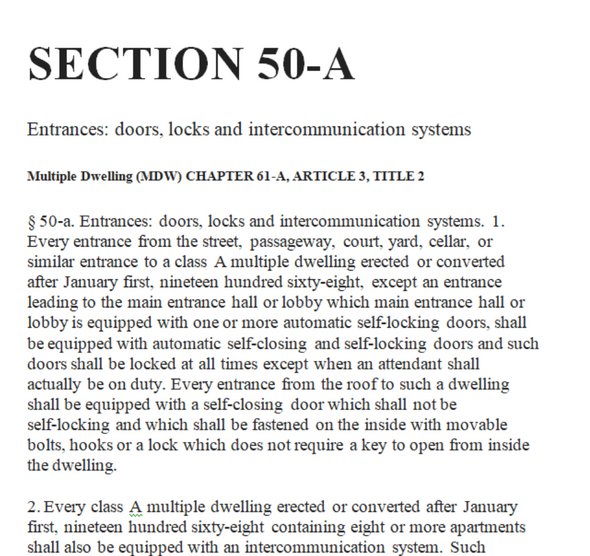
NYC LAW: INTERCOM AND BUZZ DOOR RULES (NY Multiple Dwelling Law §50-a, pdf file)
hpdsigns.nyc
January 2026 package of HPD-required notices for landlords (pdf file)
hpdsigns.nyc

Inspections of Self-Closing Doors rule by city of NY (pdf file)
hpdsigns.nyc

NY filing Due dates (pdf file)
hpdsigns.nyc