
hpdsigns.nyc
Disaster Signage Requirements / Emergency Notification (Local Law 98,pdf )
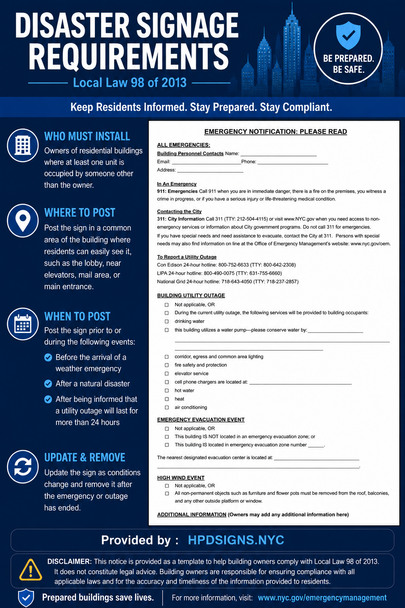
- SKU:
- Disaster Signage Requirements (Local Law 98,pdf )
- MPN:
- Disaster Signage Requirements (Local Law 98,pdf )




Description
LEGAL DISCLAIMER, LIMITATION OF LIABILITY, AND TERMS OF USE
INDEPENDENT SMALL FAMILY-OWNED BUSINESS NOTICE
We are an independent privately owned small family-owned business operating in the United States.
We are NOT the City of New York, HPD, DOB, FDNY, DSNY, DEP, DOT, DHCR, HUD, OSHA, EPA, FEMA, any state agency, any federal agency, or any governmental, quasi-governmental, regulatory, enforcement, housing, building, fire, transportation, sanitation, environmental, health, public safety, or public authority organization.
We are not affiliated with, endorsed by, approved by, sponsored by, authorized by, certified by, partnered with, or connected in any manner with any governmental agency or authority.
Any references to governmental agencies, laws, regulations, codes, standards, ordinances, inspections, notices, permits, requirements, compliance programs, enforcement actions, or public resources are provided solely for informational and descriptive purposes and do not imply endorsement, approval, certification, sponsorship, authorization, partnership, or affiliation.
Many governmental publications, flyers, brochures, forms, notices, checklists, and educational materials referenced, reproduced, summarized, attached, linked, or distributed by our company are publicly available documents that may be obtained directly from the applicable government agency, often at no charge.
INFORMATIONAL PURPOSES ONLY
All content, products, services, signs, sign packages, notices, brochures, flyers, downloadable files, PDF documents, checklists, product descriptions, blog articles, compliance guides, customer communications, emails, specifications, marketing materials, and related information are provided solely for general informational and educational purposes.
Information may become outdated, amended, revised, superseded, interpreted differently, or withdrawn without notice.
Laws, regulations, building codes, fire codes, housing requirements, inspection procedures, accessibility requirements, environmental regulations, insurance requirements, safety standards, and governmental policies frequently change and may vary by jurisdiction, occupancy type, building classification, property use, location, agency interpretation, and individual circumstances.
We make no representation, warranty, or guarantee that any information provided is accurate, complete, current, reliable, applicable, legally sufficient, or appropriate for any specific situation.
Users assume all risk associated with reliance upon any information provided.
NO PROFESSIONAL ADVICE
Nothing provided by our company shall be construed as:
• Legal advice
• Engineering advice
• Architectural advice
• Fire protection advice
• Life safety advice
• Accessibility advice
• ADA compliance advice
• Building code advice
• Fire code advice
• Housing code advice
• Inspection advice
• Regulatory advice
• Tax advice
• Insurance advice
• Real estate advice
• Environmental advice
• Construction advice
• Property management advice
• Professional consulting services of any kind
No attorney-client, consultant-client, architect-client, engineer-client, contractor-client, professional-client, or fiduciary relationship is created through the use of our website, purchase of products, receipt of materials, or communication with our company.
Customers should consult qualified attorneys, architects, engineers, code consultants, licensed contractors, fire protection professionals, insurance professionals, accountants, and applicable governmental authorities regarding their specific circumstances.
GOVERNMENT PUBLICATION DISCLAIMER
Any government-related document, brochure, flyer, checklist, guide, notice, publication, form, or educational material distributed by our company is provided solely as a convenience to customers.
Such materials remain the property of their respective agencies and organizations.
Our company does not create, maintain, update, approve, certify, validate, or control the contents of such governmental publications.
Government agencies may revise, amend, replace, withdraw, reinterpret, or update such materials at any time without notice.
Customers should always consult the original official governmental source for the most current information.
Official government publications, agency guidance, statutes, regulations, rules, code provisions, interpretations, and enforcement positions shall always control over any summary, reproduction, attachment, description, reference, or explanation provided by our company.
CUSTOMER RESPONSIBILITY FOR COMPLIANCE
The customer, property owner, landlord, management company, architect, engineer, contractor, installer, purchaser, building owner, consultant, and end user bear sole and exclusive responsibility for determining:
• Whether signage is required
• What signage is required
• Applicable laws and regulations
• Sign wording and content
• Sign dimensions and specifications
• Material requirements
• Installation requirements
• Placement requirements
• Inspection requirements
• Permit requirements
• Accessibility requirements
• Fire safety requirements
• Building safety requirements
• Environmental requirements
• Insurance requirements
• Operational requirements
Purchasing any sign, sign package, decal, placard, marker, notice, template, guide, checklist, flyer, brochure, or informational material from us does not constitute compliance with any law, code, regulation, ordinance, permit, inspection requirement, insurance requirement, governmental directive, court order, or regulatory obligation.
SIGNAGE DISCLAIMER
All signs, labels, notices, placards, decals, markers, plates, directories, room identification signs, building signs, compliance signs, and related products are provided solely as physical products.
We do not certify, guarantee, warrant, represent, or promise that any product:
• Meets any legal requirement
• Meets any code requirement
• Passes any inspection
• Satisfies any governmental requirement
• Creates legal compliance
• Creates regulatory compliance
• Meets insurance requirements
• Meets accessibility requirements
• Meets ADA requirements
• Meets OSHA requirements
• Meets FDNY requirements
• Meets HPD requirements
• Meets DOB requirements
• Prevents injury or property damage
• Eliminates legal obligations
• Eliminates regulatory obligations
The purchaser is solely responsible for determining suitability for the intended application.
INSTALLATION DISCLAIMER
Improper installation may create safety hazards, accessibility issues, regulatory violations, inspection failures, property damage, personal injury, or death.
We assume no responsibility whatsoever for:
• Installation methods
• Installation locations
• Placement decisions
• Fasteners selected
• Adhesive selection
• Structural attachment methods
• Mounting surfaces
• Electrical connections
• Maintenance practices
• Visibility requirements
• Accessibility requirements
• Inspection outcomes
All installation decisions remain the sole responsibility of the purchaser, installer, contractor, property owner, and building owner.
DISCLAIMER OF WARRANTIES
TO THE MAXIMUM EXTENT PERMITTED BY LAW, ALL PRODUCTS, SERVICES, INFORMATION, DOCUMENTS, DOWNLOADS, PUBLICATIONS, COMMUNICATIONS, AND MATERIALS ARE PROVIDED "AS IS," "WITH ALL FAULTS," AND "AS AVAILABLE."
WE EXPRESSLY DISCLAIM ALL WARRANTIES OF ANY KIND, WHETHER EXPRESS, IMPLIED, STATUTORY, OR OTHERWISE, INCLUDING WITHOUT LIMITATION:
• MERCHANTABILITY
• FITNESS FOR A PARTICULAR PURPOSE
• NON-INFRINGEMENT
• ACCURACY
• COMPLETENESS
• RELIABILITY
• PERFORMANCE
• DURABILITY
• CODE COMPLIANCE
• REGULATORY COMPLIANCE
• INSPECTION APPROVAL
NO ORAL OR WRITTEN STATEMENT SHALL CREATE ANY WARRANTY NOT EXPRESSLY SET FORTH IN A WRITTEN AGREEMENT SIGNED BY AN AUTHORIZED REPRESENTATIVE OF OUR COMPANY.
LIMITATION OF LIABILITY
TO THE MAXIMUM EXTENT PERMITTED BY LAW, OUR COMPANY, ITS OWNERS, FAMILY MEMBERS, EMPLOYEES, OFFICERS, DIRECTORS, AGENTS, REPRESENTATIVES, CONTRACTORS, SUCCESSORS, ASSIGNS, SUPPLIERS, DISTRIBUTORS, AFFILIATES, AND SERVICE PROVIDERS SHALL NOT BE LIABLE FOR ANY:
• Direct damages
• Indirect damages
• Consequential damages
• Incidental damages
• Special damages
• Punitive damages
• Exemplary damages
• Lost profits
• Lost revenue
• Lost business opportunities
• Business interruption damages
• Loss of use
• Loss of data
• Property damage
• Personal injury
• Bodily injury
• Death
• Government fines
• Civil penalties
• Violations
• Citations
• Inspection failures
• Enforcement actions
• Attorney fees
• Litigation expenses
• Regulatory actions
WHETHER ARISING FROM CONTRACT, TORT, NEGLIGENCE, STRICT LIABILITY, PRODUCT LIABILITY, WARRANTY, STATUTE, EQUITY, OR ANY OTHER LEGAL THEORY.
MAXIMUM LIABILITY CAP
IN ALL CIRCUMSTANCES, THE MAXIMUM AGGREGATE LIABILITY OF OUR COMPANY SHALL NOT EXCEED THE ACTUAL PURCHASE PRICE PAID FOR THE SPECIFIC PRODUCT THAT GAVE RISE TO THE CLAIM.
INDEMNIFICATION
The customer agrees to defend, indemnify, and hold harmless our company, its owners, family members, officers, employees, contractors, affiliates, successors, and assigns from and against any and all claims, demands, damages, losses, liabilities, penalties, fines, judgments, settlements, costs, expenses, and attorney fees arising from:
• Product use
• Product misuse
• Product installation
• Product modification
• Regulatory non-compliance
• Inspection failures
• Customer-provided content
• Customer instructions
• Property conditions
• Building conditions
• Third-party claims
THIRD-PARTY LINKS AND EXTERNAL RESOURCES
Any hyperlinks or references to government agencies, websites, laws, regulations, standards, organizations, publications, or third-party resources are provided solely as a convenience.
We do not control, endorse, verify, guarantee, maintain, or assume responsibility for third-party content and shall not be liable for any reliance placed upon such content.
GOVERNING LAW AND VENUE
This Legal Disclaimer, Limitation of Liability, and Terms of Use shall be governed by and construed under the laws of the State of New York, without regard to conflict-of-law principles.
Any dispute, claim, or legal proceeding shall be brought exclusively in the state or federal courts located within the State of New York.
ACCEPTANCE OF TERMS
By accessing our website, downloading materials, receiving information, purchasing products, requesting services, viewing content, or using any product, document, publication, flyer, guide, brochure, checklist, sign, or informational material provided by our company, the user acknowledges that they have read, understood, and agreed to be bound by this Legal Disclaimer, Limitation of Liability, and Terms of Use.
Related Products


HPD Disaster Response Signage /Emergency Notification SIGN (WHITE, 27-2005)-El blanco Line
HPDSIGNS.COM


Emergency Notification prior to the arrival of a weather emergency (pdf file)
hpdsigns.nyc


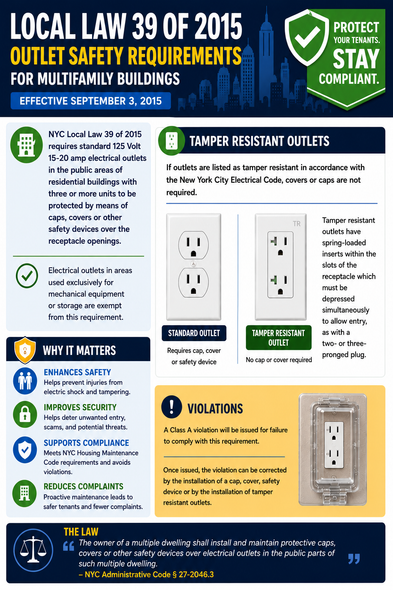

NYC Common Area Electrical Outlet Safety Requirements Under Local Law 39 +27-2046.3(pdf file)
hpdsigns.nyc