DEFECTIVE ELECTRICAL OUTLETS & STANDARD WIRING VIOLATIONS -NYC Admin Code § 27-2005+ checklist ( PDF FILE)
(No reviews yet) Write a Review
SKU:
DEFECTIVE ELECTRICAL OUTLETS & STANDARD WIRING VIOLATIONS -NYC Admin Code § 27-2005— ( PDF FILE)
MPN:
NYC Admin Code § 27-2005— ( PDF FILE)
  • DEFECTIVE ELECTRICAL OUTLETS & STANDARD WIRING VIOLATIONS -NYC Admin Code § 27-2005
  • DEFECTIVE ELECTRICAL OUTLETS & STANDARD WIRING VIOLATIONS -NYC Admin Code § 27-2005
  • DEFECTIVE ELECTRICAL OUTLETS & STANDARD WIRING VIOLATIONS -NYC Admin Code § 27-2005+ checklist  ( PDF FILE)
$0.00
Frequently bought together:

Description

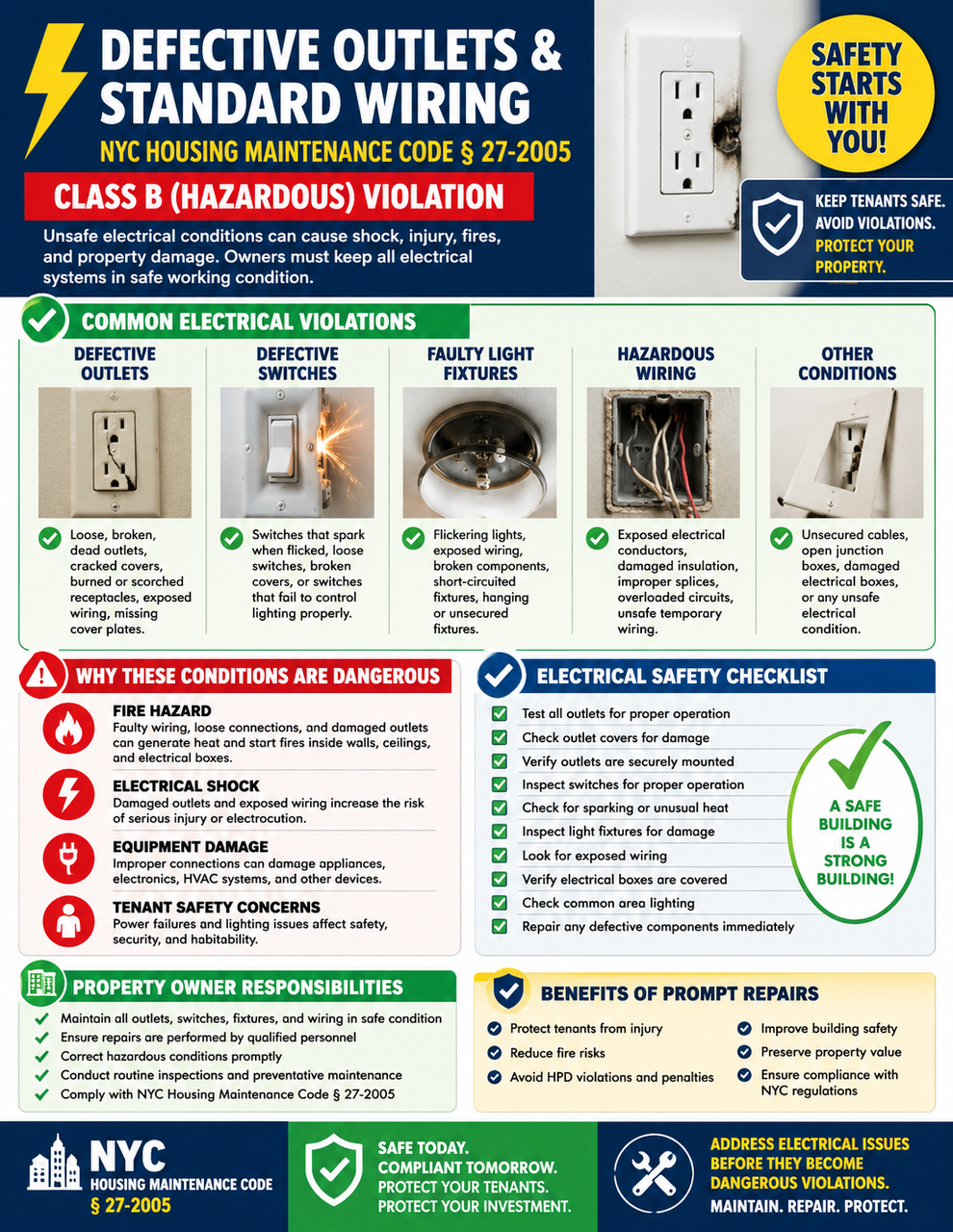
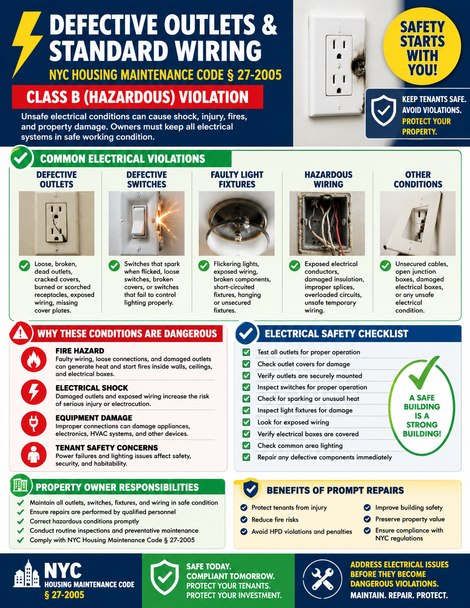
DEFECTIVE ELECTRICAL OUTLETS & STANDARD WIRING VIOLATIONS

NYC Housing Maintenance Code § 27-2005

Class B (Hazardous) Violation


DEFECTIVE ELECTRICAL OUTLETS AND STANDARD WIRING

Understanding Class B Hazardous Violations in New York City

Electrical systems are a critical safety component of every residential building. Defective electrical outlets, switches, wiring, and lighting fixtures can create serious hazards for tenants, including electrical shock, burns, property damage, and fire. Under the New York City Housing Maintenance Code, defective electrical conditions are commonly cited as hazardous (Class B) violations requiring prompt correction by the property owner.

What Is a Class B Hazardous Violation?

A Class B violation is considered hazardous because the condition presents a potential danger to occupants if left uncorrected. While not immediately life-threatening like a Class C violation, defective electrical equipment can rapidly develop into a more serious safety issue. Property owners are responsible for maintaining all electrical fixtures, outlets, switches, and wiring in safe working condition.

Common Electrical Violations Found by HPD

The following conditions frequently result in hazardous violations:

Defective Electrical Outlets

  • Loose outlets that move within the wall
  • Broken receptacles
  • Cracked outlet covers
  • Burned or scorched outlets
  • Dead outlets that do not provide power
  • Outlets with exposed wiring
  • Missing outlet cover plates

Defective Light Switches

  • Switches that spark when operated
  • Loose switches
  • Switches that fail to control lighting properly
  • Broken switch covers
  • Damaged switch assemblies

Faulty Light Fixtures

  • Flickering fixtures
  • Exposed wiring within fixtures
  • Broken fixture components
  • Short-circuited lighting equipment
  • Hanging or unsecured fixtures

Hazardous Wiring Conditions

  • Exposed electrical conductors
  • Damaged insulation
  • Improper splices
  • Overloaded circuits
  • Unsafe temporary wiring
  • Unsecured electrical cables

Why These Conditions Are Dangerous

Even minor electrical defects can create significant safety risks:

Fire Hazard

Faulty wiring, loose connections, and damaged outlets can generate excessive heat, leading to electrical fires within walls, ceilings, and electrical boxes.

Electrical Shock Risk

Damaged outlets and exposed wiring increase the likelihood of accidental contact with energized components, potentially causing serious injury.

Equipment Damage

Improper electrical connections can damage appliances, electronics, HVAC equipment, and other electrical devices.

Tenant Safety Concerns

Electrical failures can leave occupants without lighting or power, affecting building safety and habitability.

Property Owner Responsibilities

Building owners must ensure that:

  • All outlets are securely installed and operational.
  • Switches function properly without sparking.
  • Electrical fixtures are maintained in safe condition.
  • Wiring remains protected and free from damage.
  • Qualified personnel perform repairs when necessary.
  • Hazardous electrical conditions are corrected promptly.

Routine inspections and preventative maintenance can help identify problems before violations are issued.

Recommended Inspection Checklist

☐ Test all outlets for proper operation

☐ Check outlet covers for damage

☐ Verify outlets are securely mounted

☐ Inspect switches for proper operation

☐ Check for sparking or unusual heat

☐ Inspect light fixtures for damage

☐ Look for exposed wiring

☐ Verify electrical boxes are covered

☐ Check common area lighting

☐ Repair any defective components immediately

Benefits of Prompt Repairs

Maintaining electrical systems helps:

  • Protect tenants from injury
  • Reduce fire risks
  • Avoid HPD violations and penalties
  • Improve building safety
  • Preserve property value
  • Ensure compliance with NYC regulations

Electrical safety should always be a priority in residential buildings. Prompt identification and correction of defective outlets, switches, wiring, and fixtures helps create a safer living environment for all occupants.

Code Reference

NYC Housing Maintenance Code § 27-2005

"The owner of a multiple dwelling shall keep the premises in good repair and maintain the dwelling and its facilities in good working order."


Legal Disclaimer

This explanation is provided for general informational and educational purposes only and does not constitute legal advice, code interpretation, engineering guidance, or professional compliance services. Building codes, Housing Maintenance Code requirements, HPD interpretations, and enforcement practices may change over time or vary depending on building conditions and inspector interpretation.

We are a small independent family-owned business and are not affiliated with or endorsed by the City of New York, HPD, DOB, FDNY, or any governmental agency. Property owners, managers, contractors, and tenants are responsible for independently verifying all applicable laws, rules, lighting requirements, electrical standards, and compliance obligations with the appropriate licensed professionals and official NYC agencies before performing work or relying on this information.

Failure to comply with applicable laws may result in violations, penalties, or liability. Always consult qualified legal counsel, licensed electricians, architects, engineers, or code professionals regarding specific building conditions or compliance questions.


DISCLAIMER:This summary is provided for general informational purposes only and does not constitute legal, engineering, architectural, or code-compliance advice. Building owners, landlords, contractors, and property managers are responsible for verifying all current requirements with the applicable New York City agencies and licensed professionals. NYC laws, codes, and regulations may change over time.


DISCLAIMER: The information, images, and attached flyer are provided for informational purposes only. This flyer was originally created and distributed free of charge by the New York City Department of Sanitation (“DSNY”) and may be downloaded directly from official New York City government websites. Our company is not affiliated with, endorsed by, authorized by, or acting on behalf of DSNY or any New York City agency. We are providing this material free of charge solely as a public convenience and educational resource.

While we attempt to provide accurate and up-to-date information, laws, regulations, enforcement dates, penalties, and compliance requirements may change without notice. Property owners, managers, and buyers are solely responsible for verifying all requirements directly with official New York City sources, including DSNY and the NYC Administrative Code. Our company makes no guarantees regarding completeness, accuracy, legal compliance, or inspection acceptance and assumes no liability for errors, omissions, losses, violations, penalties, or damages arising from the use of this information or flyer.


DISCLAIMER to comply with the New York City Consumer Protection Law which applies to all businesses operating in New York City: We are small family-owned and family-operated Brooklyn-based business. We are not a City of New York store nor are the website, products or services affiliated with the City of New York or any agency of the City of New York. We ourselves, our business, websites, products, services, or any hyperlinks from its website are not sponsored by, approved by, affiliated with, endorsed by, or connected to the City of New York or any agency of the City of New York, including but not limited to HPD, DOB, DOT, DSNY, FDNY and federal directly or by implication.

DISCLAIMER These codes may not be the most recent version. The State / federal or other regulation department may have more current or accurate information. We make no warranties or guarantees about the accuracy, completeness, or adequacy of the information contained on this site or the information linked to on the state site. Please check official sources.

The requirements for sign content are determined by intended use and by applicable regulation. The BUYER is responsible for determining the appropriate content for a sign or package of signs.  WE makes no warranty or representation of suitability of a sign for any specific application. IT IS THE CUSTOMER'S RESPONSIBILITY TO ENSURE THAT THE SIGNS THE CUSTOMER ORDERS ARE IN COMPLIANCE WITH ALL STATE, FEDERAL, LOCAL, AND MUNICIPAL LAWS. Please review terms and conditions prior to purchase. 

For more information about what is required, see the laws that are referenced and the rules applicable to your city and state. This page is for informational purposes only and is not intended as legal advice, professional advice or a statement of law. You may wish to consult with an attorney.

View AllClose