
hpdsigns.nyc
25 NYC Housing Maintenance Code Safety Requirements Every Landlord Should Know (pdf file, 2026)

- SKU:
- 25 NYC Housing Maintenance Code Safety Requirements for Landlords – HPD Safety Checklist
- MPN:
- 25 NYC Housing Maintenance Code Safety


Description
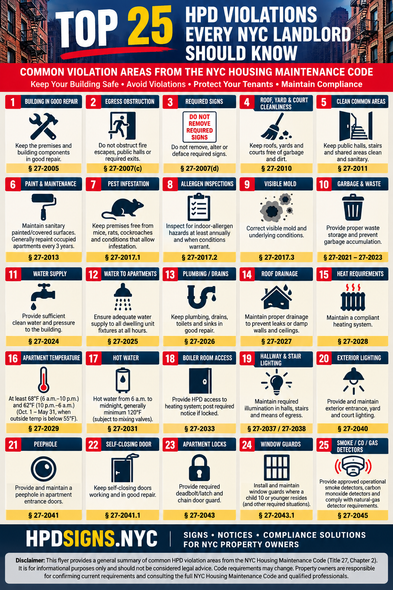
25 NYC Housing Maintenance Code Safety Requirements Every Landlord Should Know
A Practical Safety & Compliance Guide for New York City Property Owners and Landlords
Owning or managing residential property in New York City comes with important safety responsibilities. The NYC Housing Maintenance Code establishes requirements covering fire safety, detectors, doors, lighting, heat, hot water, window guards, lead paint, pests, mold, plumbing, sanitation and general building maintenance.
The following 25-point landlord safety checklist highlights important requirements that owners should regularly review. The order is intended as a practical, life-safety-focused checklist and is not an official HPD ranking of violations.
1. Smoke Detectors — NYC Admin. Code § 27-2045
Required smoke detecting devices must be provided and installed in dwelling units as required by law. Landlords should make sure required detectors are properly installed and that owner responsibilities under the section are satisfied. Missing, disconnected, damaged or non-working detectors can create a serious life-safety condition.
Landlord checklist: Confirm required smoke detectors are present in every applicable dwelling unit and address missing or defective devices promptly.
2. Carbon Monoxide Detectors — § 27-2045
Required carbon monoxide detecting devices must be provided and installed in covered dwelling units. Carbon monoxide is colorless and odorless, making properly installed detection especially important.
Typical problem: A required CO detector is missing, damaged, improperly installed or otherwise not compliant.
3. Natural-Gas Detectors — § 27-2045
Section 27-2045 also contains requirements concerning natural-gas detecting devices. Where applicable, owners must provide approved devices in accordance with the statutory requirements and applicable rules.
Landlord checklist: Determine whether the dwelling is subject to the natural-gas detector requirements and use devices that satisfy the applicable NYC requirements.
4. Self-Closing Doors — § 27-2044
Required fire-protection doors must be maintained with the required self-closing function. A door that has a closer but remains open after being released defeats an important part of the building's fire and smoke protection.
Typical problem: Broken or removed door closer, a door being propped open, or a door that fails to return to the closed position.
5. Keep Fire Escapes Clear — § 27-2007(c)
Fire escapes and access to required means of egress must not be obstructed. Items placed on or in front of a fire escape can interfere with emergency evacuation.
Typical problem: Furniture, bicycles, storage containers, planters, garbage or other objects obstructing access to a fire escape.
6. Keep Public Halls, Stairs & Exits Clear — § 27-2007(c)
Required means of egress and public halls must remain free from obstructions. Hallways and stairs are emergency escape routes and should not become storage areas.
Typical problem: Baby carriages, bicycles, boxes, furniture or other property narrowing or blocking a hallway, stairway or exit route.
7. Required Electric Lighting — § 27-2037
Owners must provide and maintain required electric lighting equipment, including lighting for public parts and means of egress.
A hallway light that exists but does not work does not provide the required protection.
Landlord checklist: Regularly inspect hallway, stairway and other required fixtures and replace failed lamps or repair defective fixtures promptly.
8. Minimum Public-Area Lighting — § 27-2038
Covered multiple dwellings and tenant-occupied two-family dwellings must maintain illumination of not less than one foot-candle measured at floor level throughout specified public hallways, stairs, fire stairs and fire towers at all times of day and night.
Owners must install, position, operate and maintain enough electric lighting to maintain the required illumination.
Typical problem: Dark stairs or hallways, burned-out fixtures, insufficient fixtures or areas falling below the required illumination level.
9. Window Guards — § 27-2043.1
Owners of covered multiple dwellings must provide, install and maintain approved window guards where required, including qualifying dwelling units where a child 10 years of age or younger resides.
Certain windows, including specified fire-escape and required-egress windows, are excluded from the general requirement.
Failure to provide a required window guard is specifically treated by the code as a Class C immediately hazardous violation.
Typical problem: Missing, loose, damaged or improperly installed window guards.
10. Apartment Entrance Door Locks — § 27-2043
Owners must provide a key lock on dwelling-unit entrance doors and at least one key. In a Class A multiple dwelling, the entrance door is subject to additional locking-hardware requirements, including a heavy-duty latch set and deadbolt as specified by the code.
Typical problem: Broken lock, missing required hardware or an entrance door that cannot be properly secured.
11. Chain Door Guards — § 27-2043
Dwelling-unit entrance doors in Class A multiple dwellings must also have a chain door guard permitting the door to be partially opened.
Typical problem: Missing, broken or unusable chain guard.
12. Minimum Daytime Heat — § 27-2029
During NYC's heating season, October 1 through May 31, required centrally supplied heat must maintain at least:
68°F between 6:00 a.m. and 10:00 p.m. whenever the outside temperature is below 55°F.
Owners should ensure the heating system is capable of maintaining the required indoor temperature throughout occupied living areas.
Typical problem: Apartment temperature falls below 68°F during qualifying daytime conditions.
13. Minimum Nighttime Heat — § 27-2029
During the same October 1–May 31 heating season, the required nighttime indoor temperature is:
At least 62°F from 10:00 p.m. through 6:00 a.m.
Unlike the daytime provision quoted above, the nighttime requirement in the code is not conditioned on the outdoor temperature falling below 55°F.
Typical problem: Building temperature is reduced below 62°F overnight.
14. Hot Water — § 27-2031
Covered baths, showers, washbasins and sinks must generally receive hot water between 6:00 a.m. and midnight at a constant minimum temperature of 120°F from the required source.
The code contains an exception for certain approved mixing-valve arrangements, under which bath or shower discharge may be below 120°F but not below 110°F.
Typical problem: No hot water, prolonged interruption or temperature below the applicable legal minimum.
15. Safe and Adequate Water Supply — §§ 27-2024 & 27-2025
Owners must provide a sufficient supply of pure and wholesome water at adequate pressure for sanitary use. Dwelling units must have the proper means to receive and distribute an adequate water supply during all hours.
Typical problem: No water, inadequate pressure, unsafe water connection or improper cross-connection with a drainage system.
16. Plumbing & Drainage — § 27-2026
The building's plumbing and drainage system must be properly maintained and kept in good repair. This includes toilets, water closets, sinks and other plumbing fixtures.
Typical problem: Broken toilets, defective sinks, leaking plumbing, waste-line problems or backed-up drainage.
17. Roof, Yard & Court Drainage — § 27-2027
Owners must maintain appropriate drainage from roofs, terraces, yards, courts and other applicable areas. Roof drainage must prevent storm water from causing dampness in walls, ceilings and open spaces.
Typical problem: Clogged drains, standing water, roof runoff, defective drainage or water infiltration creating damp building conditions.
18. Mold Remediation — § 27-2017.1
An indoor allergen hazard in a multiple-dwelling unit is considered a condition dangerous to health. Owners must keep premises free from covered indoor allergen hazards and expeditiously remediate qualifying conditions and their underlying defects.
For mold, simply covering the visible growth does not address a leaking pipe, defective masonry, water infiltration or another moisture condition causing the problem.
Typical problem: Mold is painted over while the underlying leak or moisture source remains.
19. Pest Control — § 27-2017.1
Owners must keep covered premises free from pests and other indoor allergen hazards and from conditions conducive to such hazards.
The code's pest provisions encompass problems such as mice, rats and cockroaches, among other pests.
Typical problem: Treating visible pests without addressing holes, entry paths, harborages or other underlying conditions allowing the infestation to continue.
20. Indoor Allergen / Pest Investigations — § 27-2017.2
Owners of multiple dwellings must conduct investigations for indoor allergen hazards in occupied dwelling units and common areas as required by the code.
Investigations are required at least once each year and more often when necessary, including circumstances involving complaints or conditions an owner knows or should know may create an indoor allergen hazard.
Typical problem: Failing to investigate after receiving a complaint concerning mold, mice, rats, cockroaches or another covered condition.
21. Lead-Based Paint Hazards — §§ 27-2056.3 & 27-2056.4
NYC imposes significant responsibilities concerning lead-based paint hazards in covered housing. Owners must take required action to prevent reasonably foreseeable lead hazards, remediate covered hazards and underlying defects, and conduct applicable investigations.
The requirements are especially important in older housing where children of the applicable age reside.
Typical problem: Peeling or deteriorated lead-based paint, failure to perform a required investigation, or failure to correct an underlying defect contributing to the hazard.
22. Garbage Receptacles — § 27-2021
Buildings must have sufficient approved waste receptacles capable of holding the building's accumulated waste as required by the code. Receptacles must hold their contents without leakage and be capable of being effectively closed.
Metal cans must have tight-fitting covers.
Typical problem: Open, overflowing or leaking garbage containers or insufficient waste receptacles.
23. Prevent Waste Accumulation — §§ 27-2022 & 27-2023
Waste cannot be allowed to accumulate in a manner creating an unsanitary condition or fire hazard. The code contains collection requirements for multiple dwellings and requirements applicable to one- and two-family dwellings.
Typical problem: Garbage bags, discarded materials or other waste accumulating in a cellar, hallway, yard, trash room or another part of the premises.
24. Keep Common Areas Clean — §§ 27-2010 & 27-2011
Owners must maintain public portions of dwellings in a clean and sanitary condition. The code also addresses cleanliness of roofs, yards, courts and other open spaces.
Typical problem: Garbage, dirt, filth or other offensive material accumulating in public or exterior areas.
25. General Duty to Keep the Property in Good Repair — § 27-2005
One of the most fundamental provisions of the Housing Maintenance Code is the owner's general duty to keep the premises in good repair and comply with applicable requirements of the code.
This broad obligation reinforces many of the specific requirements above.
Typical problem: Allowing deteriorated walls, ceilings, floors, doors, plumbing, utilities or other building components to remain defective or hazardous.
NYC LANDLORD SAFETY CHECKLIST
A landlord's compliance program should not begin only after an HPD violation is issued. Periodic building inspections can identify problems before they become more serious.
A practical routine is to check detectors, self-closing doors, fire escapes and exits, hallway lighting, window guards, entrance locks, heating and hot-water systems, plumbing, leaks, mold, pest activity, lead-paint conditions, garbage areas and common-area maintenance.
Keep records of inspections, repairs and required notices where applicable.
Important Disclaimer
This guide is provided for general informational and educational purposes only and is not legal advice. It is not an official HPD checklist or ranking of violations. Requirements may vary depending on building type, occupancy, construction, age, configuration and other circumstances. Laws, rules and enforcement requirements may change. Property owners, landlords and managers are responsible for determining and complying with all laws, rules and regulations applicable to their property. Consult the current NYC Housing Maintenance Code, applicable agency rules and a qualified professional when necessary. HPDSigns.NYC is a private business and is not affiliated with, endorsed by, or an official representative of the New York City Department of Housing Preservation and Development (HPD), the City of New York, or any other government agency.
Provided by HPDSigns.NYC
LEGAL DISCLAIMER, LIMITATION OF LIABILITY, AND TERMS OF USE
INDEPENDENT SMALL FAMILY-OWNED BUSINESS NOTICE
We are an independent privately owned small family-owned business operating in the United States.
We are NOT the City of New York, HPD, DOB, FDNY, DSNY, DEP, DOT, DHCR, HUD, OSHA, EPA, FEMA, any state agency, any federal agency, or any governmental, quasi-governmental, regulatory, enforcement, housing, building, fire, transportation, sanitation, environmental, health, public safety, or public authority organization.
We are not affiliated with, endorsed by, approved by, sponsored by, authorized by, certified by, partnered with, or connected in any manner with any governmental agency or authority.
Any references to governmental agencies, laws, regulations, codes, standards, ordinances, inspections, notices, permits, requirements, compliance programs, enforcement actions, or public resources are provided solely for informational and descriptive purposes and do not imply endorsement, approval, certification, sponsorship, authorization, partnership, or affiliation.
Many governmental publications, flyers, brochures, forms, notices, checklists, and educational materials referenced, reproduced, summarized, attached, linked, or distributed by our company are publicly available documents that may be obtained directly from the applicable government agency, often at no charge.
INFORMATIONAL PURPOSES ONLY
All content, products, services, signs, sign packages, notices, brochures, flyers, downloadable files, PDF documents, checklists, product descriptions, blog articles, compliance guides, customer communications, emails, specifications, marketing materials, and related information are provided solely for general informational and educational purposes.
Information may become outdated, amended, revised, superseded, interpreted differently, or withdrawn without notice.
Laws, regulations, building codes, fire codes, housing requirements, inspection procedures, accessibility requirements, environmental regulations, insurance requirements, safety standards, and governmental policies frequently change and may vary by jurisdiction, occupancy type, building classification, property use, location, agency interpretation, and individual circumstances.
We make no representation, warranty, or guarantee that any information provided is accurate, complete, current, reliable, applicable, legally sufficient, or appropriate for any specific situation.
Users assume all risk associated with reliance upon any information provided.
NO PROFESSIONAL ADVICE
Nothing provided by our company shall be construed as:
• Legal advice
• Engineering advice
• Architectural advice
• Fire protection advice
• Life safety advice
• Accessibility advice
• ADA compliance advice
• Building code advice
• Fire code advice
• Housing code advice
• Inspection advice
• Regulatory advice
• Tax advice
• Insurance advice
• Real estate advice
• Environmental advice
• Construction advice
• Property management advice
• Professional consulting services of any kind
No attorney-client, consultant-client, architect-client, engineer-client, contractor-client, professional-client, or fiduciary relationship is created through the use of our website, purchase of products, receipt of materials, or communication with our company.
Customers should consult qualified attorneys, architects, engineers, code consultants, licensed contractors, fire protection professionals, insurance professionals, accountants, and applicable governmental authorities regarding their specific circumstances.
GOVERNMENT PUBLICATION DISCLAIMER
Any government-related document, brochure, flyer, checklist, guide, notice, publication, form, or educational material distributed by our company is provided solely as a convenience to customers.
Such materials remain the property of their respective agencies and organizations.
Our company does not create, maintain, update, approve, certify, validate, or control the contents of such governmental publications.
Government agencies may revise, amend, replace, withdraw, reinterpret, or update such materials at any time without notice.
Customers should always consult the original official governmental source for the most current information.
Official government publications, agency guidance, statutes, regulations, rules, code provisions, interpretations, and enforcement positions shall always control over any summary, reproduction, attachment, description, reference, or explanation provided by our company.
CUSTOMER RESPONSIBILITY FOR COMPLIANCE
The customer, property owner, landlord, management company, architect, engineer, contractor, installer, purchaser, building owner, consultant, and end user bear sole and exclusive responsibility for determining:
• Whether signage is required
• What signage is required
• Applicable laws and regulations
• Sign wording and content
• Sign dimensions and specifications
• Material requirements
• Installation requirements
• Placement requirements
• Inspection requirements
• Permit requirements
• Accessibility requirements
• Fire safety requirements
• Building safety requirements
• Environmental requirements
• Insurance requirements
• Operational requirements
Purchasing any sign, sign package, decal, placard, marker, notice, template, guide, checklist, flyer, brochure, or informational material from us does not constitute compliance with any law, code, regulation, ordinance, permit, inspection requirement, insurance requirement, governmental directive, court order, or regulatory obligation.
SIGNAGE DISCLAIMER
All signs, labels, notices, placards, decals, markers, plates, directories, room identification signs, building signs, compliance signs, and related products are provided solely as physical products.
We do not certify, guarantee, warrant, represent, or promise that any product:
• Meets any legal requirement
• Meets any code requirement
• Passes any inspection
• Satisfies any governmental requirement
• Creates legal compliance
• Creates regulatory compliance
• Meets insurance requirements
• Meets accessibility requirements
• Meets ADA requirements
• Meets OSHA requirements
• Meets FDNY requirements
• Meets HPD requirements
• Meets DOB requirements
• Prevents injury or property damage
• Eliminates legal obligations
• Eliminates regulatory obligations
The purchaser is solely responsible for determining suitability for the intended application.
INSTALLATION DISCLAIMER
Improper installation may create safety hazards, accessibility issues, regulatory violations, inspection failures, property damage, personal injury, or death.
We assume no responsibility whatsoever for:
• Installation methods
• Installation locations
• Placement decisions
• Fasteners selected
• Adhesive selection
• Structural attachment methods
• Mounting surfaces
• Electrical connections
• Maintenance practices
• Visibility requirements
• Accessibility requirements
• Inspection outcomes
All installation decisions remain the sole responsibility of the purchaser, installer, contractor, property owner, and building owner.
DISCLAIMER OF WARRANTIES
TO THE MAXIMUM EXTENT PERMITTED BY LAW, ALL PRODUCTS, SERVICES, INFORMATION, DOCUMENTS, DOWNLOADS, PUBLICATIONS, COMMUNICATIONS, AND MATERIALS ARE PROVIDED "AS IS," "WITH ALL FAULTS," AND "AS AVAILABLE."
WE EXPRESSLY DISCLAIM ALL WARRANTIES OF ANY KIND, WHETHER EXPRESS, IMPLIED, STATUTORY, OR OTHERWISE, INCLUDING WITHOUT LIMITATION:
• MERCHANTABILITY
• FITNESS FOR A PARTICULAR PURPOSE
• NON-INFRINGEMENT
• ACCURACY
• COMPLETENESS
• RELIABILITY
• PERFORMANCE
• DURABILITY
• CODE COMPLIANCE
• REGULATORY COMPLIANCE
• INSPECTION APPROVAL
NO ORAL OR WRITTEN STATEMENT SHALL CREATE ANY WARRANTY NOT EXPRESSLY SET FORTH IN A WRITTEN AGREEMENT SIGNED BY AN AUTHORIZED REPRESENTATIVE OF OUR COMPANY.
LIMITATION OF LIABILITY
TO THE MAXIMUM EXTENT PERMITTED BY LAW, OUR COMPANY, ITS OWNERS, FAMILY MEMBERS, EMPLOYEES, OFFICERS, DIRECTORS, AGENTS, REPRESENTATIVES, CONTRACTORS, SUCCESSORS, ASSIGNS, SUPPLIERS, DISTRIBUTORS, AFFILIATES, AND SERVICE PROVIDERS SHALL NOT BE LIABLE FOR ANY:
• Direct damages
• Indirect damages
• Consequential damages
• Incidental damages
• Special damages
• Punitive damages
• Exemplary damages
• Lost profits
• Lost revenue
• Lost business opportunities
• Business interruption damages
• Loss of use
• Loss of data
• Property damage
• Personal injury
• Bodily injury
• Death
• Government fines
• Civil penalties
• Violations
• Citations
• Inspection failures
• Enforcement actions
• Attorney fees
• Litigation expenses
• Regulatory actions
WHETHER ARISING FROM CONTRACT, TORT, NEGLIGENCE, STRICT LIABILITY, PRODUCT LIABILITY, WARRANTY, STATUTE, EQUITY, OR ANY OTHER LEGAL THEORY.
MAXIMUM LIABILITY CAP
IN ALL CIRCUMSTANCES, THE MAXIMUM AGGREGATE LIABILITY OF OUR COMPANY SHALL NOT EXCEED THE ACTUAL PURCHASE PRICE PAID FOR THE SPECIFIC PRODUCT THAT GAVE RISE TO THE CLAIM.
INDEMNIFICATION
The customer agrees to defend, indemnify, and hold harmless our company, its owners, family members, officers, employees, contractors, affiliates, successors, and assigns from and against any and all claims, demands, damages, losses, liabilities, penalties, fines, judgments, settlements, costs, expenses, and attorney fees arising from:
• Product use
• Product misuse
• Product installation
• Product modification
• Regulatory non-compliance
• Inspection failures
• Customer-provided content
• Customer instructions
• Property conditions
• Building conditions
• Third-party claims
THIRD-PARTY LINKS AND EXTERNAL RESOURCES
Any hyperlinks or references to government agencies, websites, laws, regulations, standards, organizations, publications, or third-party resources are provided solely as a convenience.
We do not control, endorse, verify, guarantee, maintain, or assume responsibility for third-party content and shall not be liable for any reliance placed upon such content.
GOVERNING LAW AND VENUE
This Legal Disclaimer, Limitation of Liability, and Terms of Use shall be governed by and construed under the laws of the State of New York, without regard to conflict-of-law principles.
Any dispute, claim, or legal proceeding shall be brought exclusively in the state or federal courts located within the State of New York.
ACCEPTANCE OF TERMS
By accessing our website, downloading materials, receiving information, purchasing products, requesting services, viewing content, or using any product, document, publication, flyer, guide, brochure, checklist, sign, or informational material provided by our company, the user acknowledges that they have read, understood, and agreed to be bound by this Legal Disclaimer, Limitation of Liability, and Terms of Use.
Related Products

2025 HPD Signage Requirements: What Every NYC Landlord Needs to Know (pdf file)
hpdsigns.nyc


NYC housing Maintenance Code (pdf file)
hpdsigns.nyc

HPD / NYC HOUSING MAINTENANCE CODE (PDF file)
hpdsigns.nyc