hpdsigns.nyc
2026 FDNY Rules | NYC Fire Department Regulations – 3 RCNY ( 2026,PDF FILE)
- SKU:
- 2026 FDNY Rules | NYC Fire Department Regulations – 3 RCNY ( 2026,PDF FILE)
- MPN:
- 2026 FDNY Rules

Description
2026 NYC FDNY Fire Department Rules – Title 3 RCNY | Complete New York City Fire Safety Regulations Reference
2026 Edition | July 1, 2026 | New York City Fire Department (FDNY) | Title 3 RCNY
Comprehensive NYC Fire Department Rules and Fire Safety Regulations
The 2026 NYC FDNY Fire Department Rules publication is an extensive regulatory reference containing the Rules of the Fire Department of the City of New York, codified under Title 3 of the Rules of the City of New York (3 RCNY).
Dated July 1, 2026, this publication was prepared by the FDNY Code Development Unit, Bureau of Legal Affairs, and covers the rules governing a wide range of fire safety, fire prevention, building protection, emergency planning, operational, and administrative requirements throughout New York City.
This detailed reference is particularly valuable for individuals and organizations responsible for understanding and implementing fire safety requirements in residential buildings, commercial properties, construction sites, industrial facilities, and other regulated premises.
Whether you are a property manager reviewing fire safety notices, a building owner researching FDNY requirements, a fire protection contractor working with alarm and sprinkler systems, or a design professional reviewing regulatory obligations, this publication provides access to the FDNY rules organized by chapter, section, and regulatory subject.
Key Features and Benefits
-
July 1, 2026 Edition: A dated reference to FDNY rules published as of July 1, 2026.
-
Title 3 RCNY Reference: Contains the New York City Fire Department Rules with numbered sections for locating applicable regulations.
-
Extensive Regulatory Coverage: Addresses fire prevention, emergency preparedness, fire protection systems, building operations, hazardous materials, construction fire safety, and administrative procedures.
-
Building Fire Safety Information: Includes rules concerning apartment identification, stairwell markings, fire safety notices, and emergency preparedness.
-
Fire Protection Systems: Provides regulations relating to fire alarm installations, sprinkler systems, standpipe systems, and associated testing and maintenance.
-
Emergency Planning: Includes requirements and referenced appendices concerning emergency preparedness guides, evacuation plans, and fire safety notices.
-
Professional Reference: Useful for building management teams, fire safety professionals, contractors, architects, engineers, and compliance personnel.
-
Organized Regulatory Sections: Allows users to research specific FDNY rule numbers and related requirements.
Detailed Contents – NYC FDNY Rules 2026
Chapter 1 – Administration
Chapter 1 addresses FDNY administrative procedures, approvals, certifications, licensing, enforcement, and regulatory processes.
Important subjects include:
-
Pre-existing facilities and conditions under § 102-01.
-
Appeals of FDNY determinations under § 104-01.
-
Professional certification of fire alarm system design and installation under § 104-02.
-
Certification of corrected defects in fire alarm system installations under § 104-04.
-
Approval of fire alarm system design and installation under § 105-01.
-
FDNY summonses, certification of correction, and stipulation procedures under § 109-01.
-
FDNY penalty schedules under § 109-03.
-
Certificates of Approval under § 112-01.
-
Certificates of Fitness and Certificates of Qualification under § 113-01.
-
Fire and Life Safety Director certification and training requirements.
-
Construction Site Fire Safety Manager qualifications and training.
-
Company certificates and expeditor registration.
Who benefits: Building owners, property managers, fire alarm contractors, fire safety directors, and professionals responsible for FDNY administrative compliance.
Chapter 2 – Definitions
Chapter 2 includes § 202-01, which establishes definitions used throughout the FDNY rules.
These definitions assist readers in interpreting regulatory terminology and understanding how the rules apply to specific facilities, equipment, activities, and fire safety conditions.
Chapter 3 – General Precautions Against Fire
Chapter 3 covers specific fire prevention precautions and regulated activities.
Topics include:
-
Liquid-fueled tar kettles and asphalt melters.
-
Coke-fueled salamanders.
-
Use of open flames in assembly occupancies and similar public gathering places.
-
Design requirements for "No Smoking" signs under § 310-02.
-
Hookah establishment requirements.
-
Sale of kerosene space heaters.
-
Indoor display of motor vehicles and watercraft.
-
Storage of flammable plastic foam products.
This chapter is useful for contractors, commercial operators, building management personnel, and businesses engaged in regulated activities.
Chapter 4 – Emergency Planning and Preparedness
One of the most important chapters for NYC residential and commercial building management.
Chapter 4 addresses emergency preparedness, fire safety notices, evacuation planning, emergency drills, and related building requirements.
Key sections include:
§ 401-06 – Fire and Emergency Preparedness Guide, Checklist and Notices
This section addresses residential fire and emergency preparedness information and associated notices and checklists.
The publication includes:
-
Appendix 1 – Building Information Section / Fire and Emergency Preparedness Information.
-
Appendix 2 – Fire Safety Notice.
-
Appendix 3 – NYC Apartment Building Individual Emergency Preparedness / Evacuation Planning Checklist.
-
Appendix 4 – Close the Door Notice.
Additional sections include:
-
§ 401-07 – Fire and Non-Fire Emergency Drills.
-
§ 404-01 – Fire Safety and Evacuation Plans.
-
§ 404-02 – Office Building Emergency Action Plans.
-
§ 406-01 – Residential Buildings with Non-Sequential or Non-Standard Floor Numbering.
-
§ 407-01 – Fire Safety Requirements for Sidewalk Cafes and Similar Public Gathering Places.
The chapter also contains appendices addressing fire safety and evacuation plan formats for hotels, office buildings, building information cards, staffing charts, and building profiles.
Who benefits: Apartment building owners, managing agents, property managers, fire and life safety directors, hotel operators, commercial building managers, and emergency preparedness professionals.
Chapter 5 – Fire Operations Features
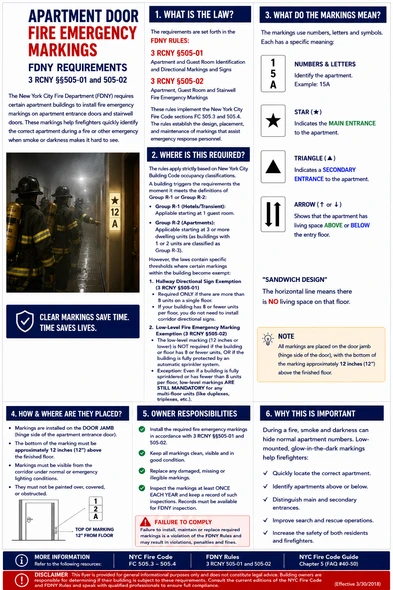
Chapter 5 addresses building identification and emergency markings that assist emergency responders in locating apartments, rooms, stairwells, and other important building areas.
Key regulations include:
§ 505-01 – Apartment and Guest Room Identification and Directional Markings and Signs
Covers requirements concerning apartment and guest room identification and directional markings.
§ 505-02 – Apartment, Guest Room and Stairwell Fire Emergency Markings
Addresses fire emergency identification and marking requirements for designated building areas.
§ 510-01 – In-Building Auxiliary Radio Communication Systems
Addresses certain in-building emergency radio communication systems.
This chapter is particularly relevant to building owners, property managers, contractors, architects, and suppliers of building identification and fire emergency signage.
Chapter 6 – Building Services and Systems
Chapter 6 addresses certain building service systems and equipment.
Included sections cover:
-
Removal of lubricating oil from ammonia refrigerating systems under § 606-01.
-
Outdoor stationary energy storage systems under § 608-01.
These rules may be relevant to specialized building facilities, mechanical contractors, industrial operators, and energy storage system professionals.
Chapter 7 – Fire-Resistant Rated Construction
Chapter 7 is identified in the publication as Fire-Resistant Rated Construction. Its listed sections are reserved.
Chapter 8 – Interior Furnishings, Decorations and Scenery
Chapter 8 addresses specific fire safety requirements for decorations and scenery.
Subjects include:
-
§ 805-01 – Flame-Resistant Decorations.
-
§ 805-02 – Flame-Retardant Scenery.
Relevant users may include event venues, theaters, entertainment facilities, building operators, and professionals responsible for decorative materials.
Chapter 9 – Fire Protection Systems
Chapter 9 provides rules relating to fire protection systems and their operation, maintenance, monitoring, and testing.
Important sections include:
-
§ 901-01 – Central Station Monitoring of Fire Alarm Systems.
-
§ 901-02 – Maintenance of Sprinkler System Pressure Tanks.
-
§ 903-01 – Flow Testing of Residential Sprinkler Systems.
-
§ 904-01 – Clean Agent Fire Extinguishing Systems Acceptance Testing.
-
§ 905-01 – Standpipe System Pressure Reducing Devices.
-
§ 907-01 – Fire Alarm Recordkeeping, Smoke Detector Maintenance, Testing and Recordkeeping, and the Prevention of Unnecessary and Unwarranted Fire Alarms.
-
§ 912-01 – Periodic Testing of Standpipe and Sprinkler Systems with Fire Department Connections.
This chapter is useful for fire alarm contractors, sprinkler and standpipe contractors, building maintenance personnel, property managers, and fire protection consultants.
Chapter 10 – Means of Egress
Chapter 10 addresses specific requirements relating to emergency exits and escape provisions.
The publication includes:
§ 1025-01 – Fire Escape Window Gates and Similar Security Devices for Secondary Means of Egress and Emergency Escape and Rescue Openings.
This section is particularly relevant when evaluating security devices installed in locations used for emergency escape or rescue.
Chapters 20–32 – Specialized Facilities and Regulated Activities
The publication contains rules addressing a variety of specialized operations and facilities, including:
-
Aviation facilities and operations.
-
Dry cleaning.
-
Combustible dust-producing operations.
-
Motor fuel-dispensing facilities and repair garages.
-
Flammable finishes.
-
Fruit and crop ripening.
-
Fumigation and insecticidal fogging.
-
Semiconductor fabrication facilities.
-
Lumber yards and wood waste materials.
-
Manufacture of organic coatings.
-
Industrial furnaces.
-
Tents and other membrane structures.
-
High-piled combustible storage.
Some chapters contain reserved sections, while others establish requirements for particular regulated activities.
Chapter 33 – Fire Safety During Construction, Alteration and Demolition
Chapter 33 addresses FDNY requirements relating to construction-site fire safety.
Topics include:
-
§ 3301-01 – Enforcement of Fire Safety at Construction Sites.
-
§ 3303-01 – Portable Space Heaters Fueled by Piped Natural Gas at Construction Sites.
-
§ 3305-01 – Crane Aerial Fueling Operations.
-
§ 3308-01 – Construction Site Fire Safety Manager.
This chapter is particularly relevant to general contractors, construction site managers, developers, site safety professionals, and fire safety personnel.
Chapters 34–40 – Specialized Fire Safety Operations
These chapters address subjects including:
-
Tire rebuilding and tire storage.
-
Welding and other hot work.
-
Use of oxygen and flammable gases.
-
Piped natural gas and oxygen-consuming devices and installations.
-
Marinas.
-
Combustible fibers.
-
Distillery operations.
These provisions are relevant to businesses and contractors conducting the activities covered by the applicable rules.
Chapters 50–67 – Hazardous Materials and Dangerous Substances
The FDNY rules also cover the regulation of various hazardous materials and specialized storage or handling operations.
The publication includes chapters concerning:
-
Hazardous materials – general provisions.
-
Aerosols.
-
Compressed gases.
-
Corrosive materials.
-
Cryogenic fluids.
-
Explosives, fireworks, and special effects.
-
Flammable and combustible liquids.
-
Flammable gases.
-
Flammable solids.
-
Highly toxic and toxic materials.
-
Liquefied petroleum gases.
-
Organic peroxides.
-
Oxidizers.
-
Pyrophoric materials.
-
Pyroxylin plastics.
-
Unstable reactive materials.
-
Water-reactive solids and liquids.
These chapters provide reference material for industrial facilities, storage operators, specialized contractors, laboratories, and other regulated businesses.
Chapters 80–84 – Referenced Standards, Fees and Pre-Existing Facilities
The later chapters address additional regulatory matters, including:
Chapter 80 – Referenced Standards
Chapter 81 – Fees
Includes provisions concerning compensation for operation of auxiliary fire alarm systems.
Chapter 82 – Referenced Standard Modifications
Includes § 8201-01 concerning modifications and amendments to referenced standards.
Chapter 83 – Pre-Existing Facilities
Contains provisions applicable to certain pre-existing facilities and conditions, including fire protection systems, means of egress, motor fuel facilities, hazardous materials, compressed gases, and other regulated storage and operations.
Chapter 84 – Miscellaneous
Includes provisions concerning adjudications and charges for Fire Department ambulance treatment and transport services.
Who Should Purchase This Publication?
NYC Building Owners and Landlords
Research FDNY rules that may apply to residential and commercial buildings, including emergency preparedness notices, building identification, fire protection systems, and other operational requirements.
Property Managers and Managing Agents
Use the publication as a reference when reviewing fire safety responsibilities, coordinating building maintenance, researching inspection-related requirements, or communicating with fire protection contractors.
Fire Safety Directors and Building Safety Personnel
Review applicable provisions concerning emergency preparedness, evacuation planning, fire drills, training, certifications, and fire safety procedures.
Architects, Engineers and Design Professionals
Research FDNY regulations relevant to building design, fire protection installations, emergency communication systems, and regulated facilities.
Fire Alarm, Sprinkler and Standpipe Contractors
Consult rule sections addressing fire alarm system design and installation, testing, maintenance, monitoring, and related procedures.
General Contractors and Construction Professionals
Reference FDNY rules addressing construction-site fire safety, hot work, temporary heating, and other regulated construction activities.
Building Signage and Fire Safety Sign Suppliers
Research the regulatory sections addressing certain fire safety notices, apartment and stairwell identification, directional markings, and other signage-related requirements.
Product Specifications
-
Document Title: Fire Department Rules
-
Regulatory Title: Title 3 of the Rules of the City of New York
-
Agency: Fire Department of the City of New York
-
Prepared By: Code Development Unit, Bureau of Legal Affairs
-
Publication Date: July 1, 2026
-
Edition: 2026
-
Language: English
-
Uploaded Source: 783-page PDF
-
Coverage: New York City
-
Subject: Fire Prevention, Fire Safety, Emergency Preparedness and Fire Department Regulations
-
Product Format: To be specified by seller
Important Regulatory Information
This publication is a dated reference to the Rules of the Fire Department of the City of New York as presented in the July 1, 2026 document.
FDNY rules, the New York City Fire Code, the New York City Building Code, and other applicable laws and standards may impose additional requirements. The rules may also be amended after the date of publication.
Purchasers are responsible for confirming which regulations apply to their building, business, equipment, or activities and for verifying the latest applicable requirements.
Disclaimer: This publication is offered as an independent reference product. The seller is not affiliated with, sponsored by, or endorsed by the FDNY or the City of New York. Purchase of this publication does not constitute FDNY approval, certification, or confirmation of code compliance.
LEGAL DISCLAIMER, LIMITATION OF LIABILITY, AND TERMS OF USE
INDEPENDENT SMALL FAMILY-OWNED BUSINESS NOTICE
We are an independent privately owned small family-owned business operating in the United States.
We are NOT the City of New York, HPD, DOB, FDNY, DSNY, DEP, DOT, DHCR, HUD, OSHA, EPA, FEMA, any state agency, any federal agency, or any governmental, quasi-governmental, regulatory, enforcement, housing, building, fire, transportation, sanitation, environmental, health, public safety, or public authority organization.
We are not affiliated with, endorsed by, approved by, sponsored by, authorized by, certified by, partnered with, or connected in any manner with any governmental agency or authority.
Any references to governmental agencies, laws, regulations, codes, standards, ordinances, inspections, notices, permits, requirements, compliance programs, enforcement actions, or public resources are provided solely for informational and descriptive purposes and do not imply endorsement, approval, certification, sponsorship, authorization, partnership, or affiliation.
Many governmental publications, flyers, brochures, forms, notices, checklists, and educational materials referenced, reproduced, summarized, attached, linked, or distributed by our company are publicly available documents that may be obtained directly from the applicable government agency, often at no charge.
INFORMATIONAL PURPOSES ONLY
All content, products, services, signs, sign packages, notices, brochures, flyers, downloadable files, PDF documents, checklists, product descriptions, blog articles, compliance guides, customer communications, emails, specifications, marketing materials, and related information are provided solely for general informational and educational purposes.
Information may become outdated, amended, revised, superseded, interpreted differently, or withdrawn without notice.
Laws, regulations, building codes, fire codes, housing requirements, inspection procedures, accessibility requirements, environmental regulations, insurance requirements, safety standards, and governmental policies frequently change and may vary by jurisdiction, occupancy type, building classification, property use, location, agency interpretation, and individual circumstances.
We make no representation, warranty, or guarantee that any information provided is accurate, complete, current, reliable, applicable, legally sufficient, or appropriate for any specific situation.
Users assume all risk associated with reliance upon any information provided.
NO PROFESSIONAL ADVICE
Nothing provided by our company shall be construed as:
• Legal advice
• Engineering advice
• Architectural advice
• Fire protection advice
• Life safety advice
• Accessibility advice
• ADA compliance advice
• Building code advice
• Fire code advice
• Housing code advice
• Inspection advice
• Regulatory advice
• Tax advice
• Insurance advice
• Real estate advice
• Environmental advice
• Construction advice
• Property management advice
• Professional consulting services of any kind
No attorney-client, consultant-client, architect-client, engineer-client, contractor-client, professional-client, or fiduciary relationship is created through the use of our website, purchase of products, receipt of materials, or communication with our company.
Customers should consult qualified attorneys, architects, engineers, code consultants, licensed contractors, fire protection professionals, insurance professionals, accountants, and applicable governmental authorities regarding their specific circumstances.
GOVERNMENT PUBLICATION DISCLAIMER
Any government-related document, brochure, flyer, checklist, guide, notice, publication, form, or educational material distributed by our company is provided solely as a convenience to customers.
Such materials remain the property of their respective agencies and organizations.
Our company does not create, maintain, update, approve, certify, validate, or control the contents of such governmental publications.
Government agencies may revise, amend, replace, withdraw, reinterpret, or update such materials at any time without notice.
Customers should always consult the original official governmental source for the most current information.
Official government publications, agency guidance, statutes, regulations, rules, code provisions, interpretations, and enforcement positions shall always control over any summary, reproduction, attachment, description, reference, or explanation provided by our company.
CUSTOMER RESPONSIBILITY FOR COMPLIANCE
The customer, property owner, landlord, management company, architect, engineer, contractor, installer, purchaser, building owner, consultant, and end user bear sole and exclusive responsibility for determining:
• Whether signage is required
• What signage is required
• Applicable laws and regulations
• Sign wording and content
• Sign dimensions and specifications
• Material requirements
• Installation requirements
• Placement requirements
• Inspection requirements
• Permit requirements
• Accessibility requirements
• Fire safety requirements
• Building safety requirements
• Environmental requirements
• Insurance requirements
• Operational requirements
Purchasing any sign, sign package, decal, placard, marker, notice, template, guide, checklist, flyer, brochure, or informational material from us does not constitute compliance with any law, code, regulation, ordinance, permit, inspection requirement, insurance requirement, governmental directive, court order, or regulatory obligation.
SIGNAGE DISCLAIMER
All signs, labels, notices, placards, decals, markers, plates, directories, room identification signs, building signs, compliance signs, and related products are provided solely as physical products.
We do not certify, guarantee, warrant, represent, or promise that any product:
• Meets any legal requirement
• Meets any code requirement
• Passes any inspection
• Satisfies any governmental requirement
• Creates legal compliance
• Creates regulatory compliance
• Meets insurance requirements
• Meets accessibility requirements
• Meets ADA requirements
• Meets OSHA requirements
• Meets FDNY requirements
• Meets HPD requirements
• Meets DOB requirements
• Prevents injury or property damage
• Eliminates legal obligations
• Eliminates regulatory obligations
The purchaser is solely responsible for determining suitability for the intended application.
INSTALLATION DISCLAIMER
Improper installation may create safety hazards, accessibility issues, regulatory violations, inspection failures, property damage, personal injury, or death.
We assume no responsibility whatsoever for:
• Installation methods
• Installation locations
• Placement decisions
• Fasteners selected
• Adhesive selection
• Structural attachment methods
• Mounting surfaces
• Electrical connections
• Maintenance practices
• Visibility requirements
• Accessibility requirements
• Inspection outcomes
All installation decisions remain the sole responsibility of the purchaser, installer, contractor, property owner, and building owner.
DISCLAIMER OF WARRANTIES
TO THE MAXIMUM EXTENT PERMITTED BY LAW, ALL PRODUCTS, SERVICES, INFORMATION, DOCUMENTS, DOWNLOADS, PUBLICATIONS, COMMUNICATIONS, AND MATERIALS ARE PROVIDED "AS IS," "WITH ALL FAULTS," AND "AS AVAILABLE."
WE EXPRESSLY DISCLAIM ALL WARRANTIES OF ANY KIND, WHETHER EXPRESS, IMPLIED, STATUTORY, OR OTHERWISE, INCLUDING WITHOUT LIMITATION:
• MERCHANTABILITY
• FITNESS FOR A PARTICULAR PURPOSE
• NON-INFRINGEMENT
• ACCURACY
• COMPLETENESS
• RELIABILITY
• PERFORMANCE
• DURABILITY
• CODE COMPLIANCE
• REGULATORY COMPLIANCE
• INSPECTION APPROVAL
NO ORAL OR WRITTEN STATEMENT SHALL CREATE ANY WARRANTY NOT EXPRESSLY SET FORTH IN A WRITTEN AGREEMENT SIGNED BY AN AUTHORIZED REPRESENTATIVE OF OUR COMPANY.
LIMITATION OF LIABILITY
TO THE MAXIMUM EXTENT PERMITTED BY LAW, OUR COMPANY, ITS OWNERS, FAMILY MEMBERS, EMPLOYEES, OFFICERS, DIRECTORS, AGENTS, REPRESENTATIVES, CONTRACTORS, SUCCESSORS, ASSIGNS, SUPPLIERS, DISTRIBUTORS, AFFILIATES, AND SERVICE PROVIDERS SHALL NOT BE LIABLE FOR ANY:
• Direct damages
• Indirect damages
• Consequential damages
• Incidental damages
• Special damages
• Punitive damages
• Exemplary damages
• Lost profits
• Lost revenue
• Lost business opportunities
• Business interruption damages
• Loss of use
• Loss of data
• Property damage
• Personal injury
• Bodily injury
• Death
• Government fines
• Civil penalties
• Violations
• Citations
• Inspection failures
• Enforcement actions
• Attorney fees
• Litigation expenses
• Regulatory actions
WHETHER ARISING FROM CONTRACT, TORT, NEGLIGENCE, STRICT LIABILITY, PRODUCT LIABILITY, WARRANTY, STATUTE, EQUITY, OR ANY OTHER LEGAL THEORY.
MAXIMUM LIABILITY CAP
IN ALL CIRCUMSTANCES, THE MAXIMUM AGGREGATE LIABILITY OF OUR COMPANY SHALL NOT EXCEED THE ACTUAL PURCHASE PRICE PAID FOR THE SPECIFIC PRODUCT THAT GAVE RISE TO THE CLAIM.
INDEMNIFICATION
The customer agrees to defend, indemnify, and hold harmless our company, its owners, family members, officers, employees, contractors, affiliates, successors, and assigns from and against any and all claims, demands, damages, losses, liabilities, penalties, fines, judgments, settlements, costs, expenses, and attorney fees arising from:
• Product use
• Product misuse
• Product installation
• Product modification
• Regulatory non-compliance
• Inspection failures
• Customer-provided content
• Customer instructions
• Property conditions
• Building conditions
• Third-party claims
THIRD-PARTY LINKS AND EXTERNAL RESOURCES
Any hyperlinks or references to government agencies, websites, laws, regulations, standards, organizations, publications, or third-party resources are provided solely as a convenience.
We do not control, endorse, verify, guarantee, maintain, or assume responsibility for third-party content and shall not be liable for any reliance placed upon such content.
GOVERNING LAW AND VENUE
This Legal Disclaimer, Limitation of Liability, and Terms of Use shall be governed by and construed under the laws of the State of New York, without regard to conflict-of-law principles.
Any dispute, claim, or legal proceeding shall be brought exclusively in the state or federal courts located within the State of New York.
ACCEPTANCE OF TERMS
By accessing our website, downloading materials, receiving information, purchasing products, requesting services, viewing content, or using any product, document, publication, flyer, guide, brochure, checklist, sign, or informational material provided by our company, the user acknowledges that they have read, understood, and agreed to be bound by this Legal Disclaimer, Limitation of Liability, and Terms of Use.
Related Products


NYC Fire department rules 2021 (PDF FILE)
hpdsigns.nyc

NYC Fire department rules 2023 (PDF FILE)
hpdsigns.nyc

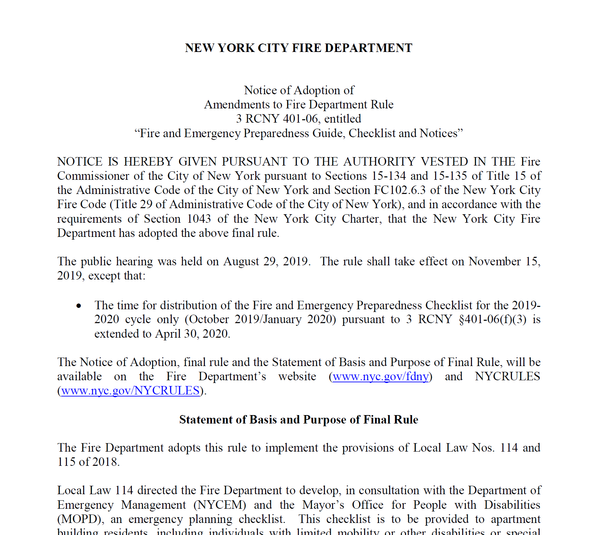
FDNY Fire and Emergency Preparedness Guide, Checklist and Notices (3 RCNY §401-06,pdf file)
hpdsigns.nyc


FDNY'S TOP SEVEN FIRE SAFETY RULES FLYER (pdf file)
hpdsigns.nyc